From the Andes to the Amazon: Our 4 Days in Tambopata National Park

After exploring the soaring heights of Arequipa and the breathtaking depths of Colca Canyon, Nikki and I found ourselves craving a completely different environment. Five months into our South American journey, we’d grown accustomed to mountains, deserts, and coastal landscapes, but the mysterious allure of the Amazon rainforest was calling our names. With our trusty camper parked safely in Puerto Maldonado, we embarked on a 4-day adventure into the heart of Tambopata National Park that would immerse us in a world unlike anything we’d experienced so far.

Day 1: Up the Tambopata River

Our journey began early in the morning as we met our guide, Carlos, at the small port in Puerto Maldonado. The contrast between the dusty frontier town and what awaited us couldn’t have been more stark. We loaded our backpacks into a long, narrow motorized canoe and settled in for our journey upriver.

As soon as we left the port behind, the transformation was immediate. The wide, coffee-colored Tambopata River stretched before us, bordered on both sides by dense walls of vibrant green jungle. The humidity hit us like a wall – after months in the relatively dry Andean climate, the thick, moisture-laden air of the Amazon felt like breathing through a wet towel. Within minutes, both Nikki and I were drenched in sweat, our clothes clinging to us as if we’d jumped into the river itself.

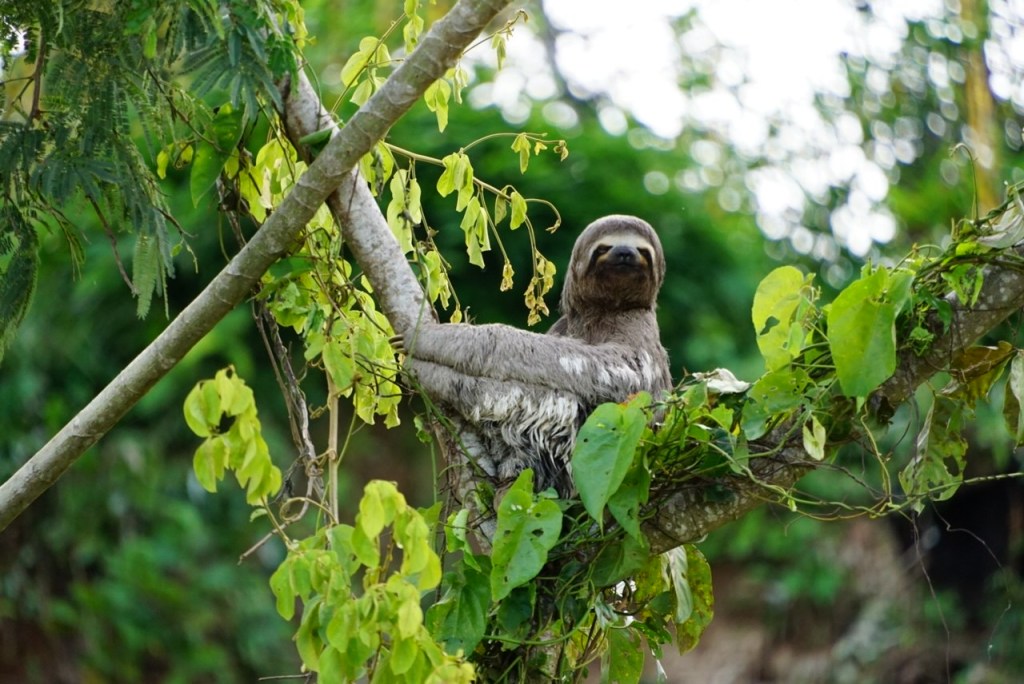
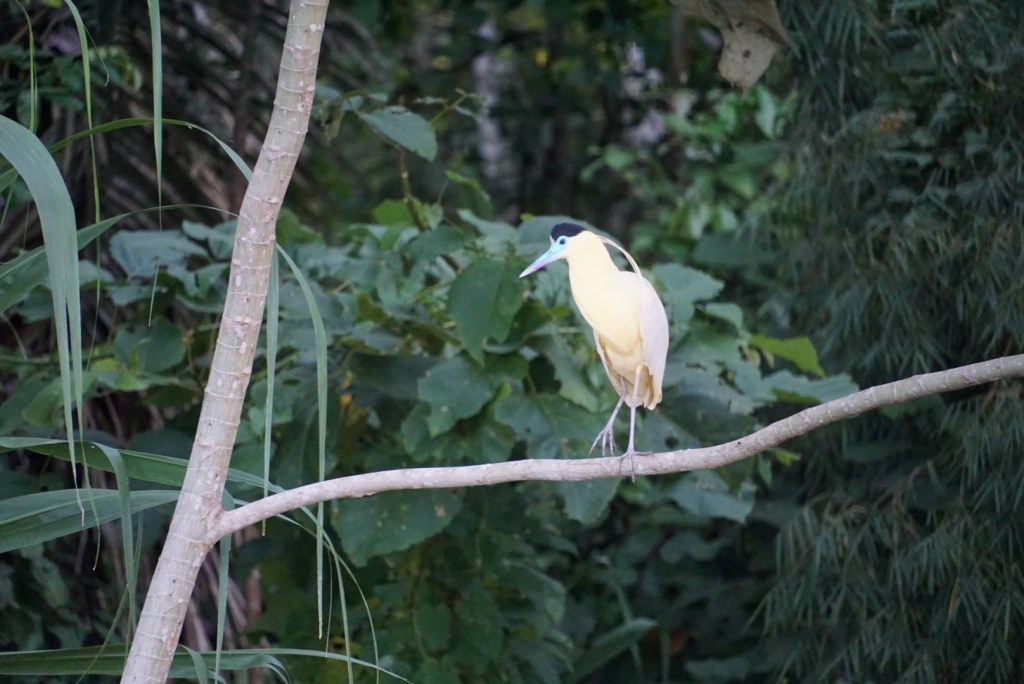
But any discomfort from the heat was quickly forgotten as the wildlife spotting began. Carlos, with his eagle eyes, pointed out birds that we would have completely missed – brilliant toucans, colorful macaws flying in pairs overhead, and herons standing statue-still along the riverbanks. About an hour into our journey, we slowed down as Carlos gestured toward what looked like just another tree branch. There, perfectly camouflaged, was a three-toed sloth, so still you might mistake it for part of the tree itself.
Further along, we spotted river turtles sunning themselves on fallen logs and, to our delight, a family of capybaras – those giant guinea pig-like creatures – grazing casually along the shoreline. The young ones scurried behind their parents as our boat approached, but the adults barely acknowledged us, continuing their methodical munching on riverside vegetation.

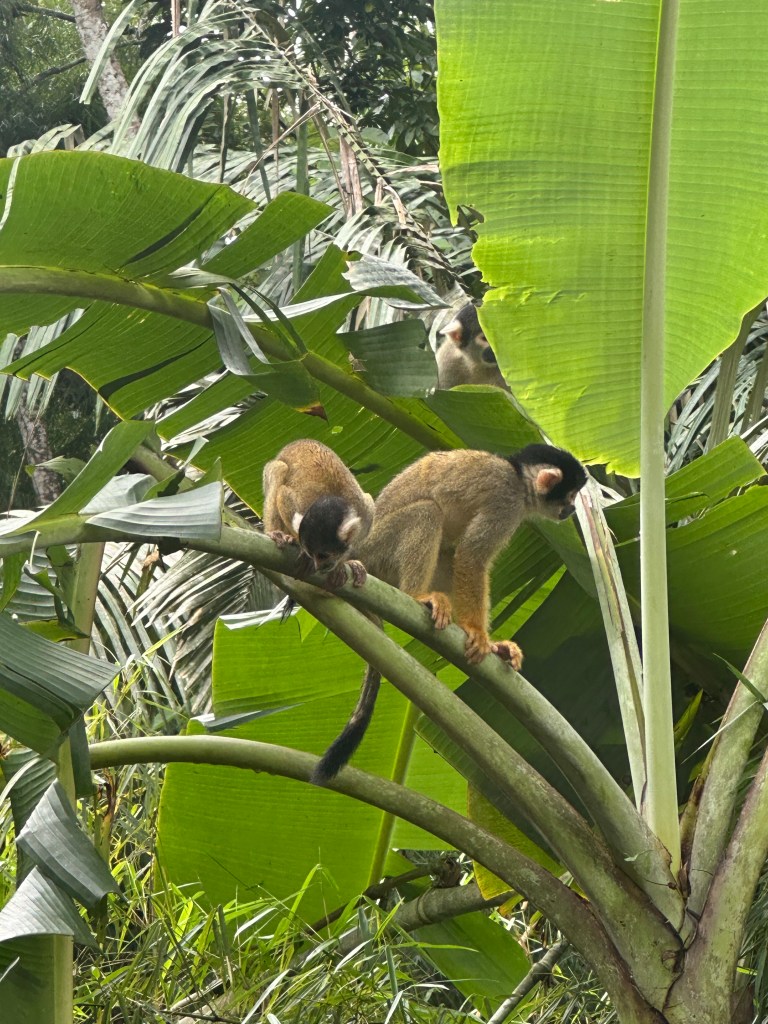
As the afternoon wore on, we were treated to the sight of several monkey troops swinging through the canopy. Carlos identified them as squirrel monkeys, their tiny bodies moving with incredible agility from branch to branch like ants of the monkey world.
By late afternoon, we arrived at our ecolodge – a collection of beautiful thatched-roof cabins connected by elevated wooden walkways, all built harmoniously within the jungle without disturbing the surrounding trees. After a refreshing cold shower (which we were finally happy about due to the unrelenting heat) and a delicious dinner of local fish wrapped in banana leaves, Carlos proposed a night hike.

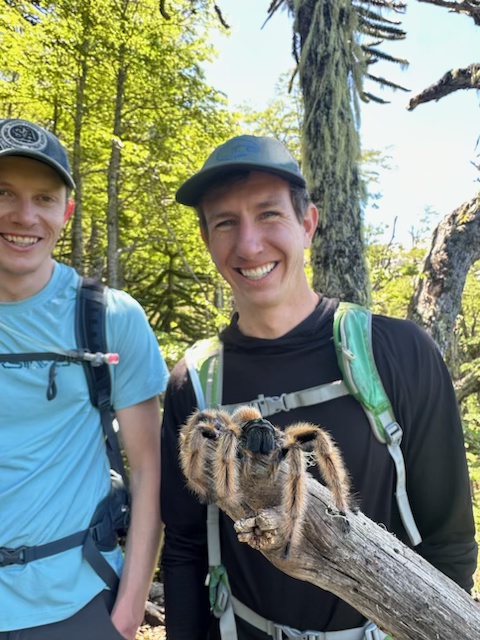
Equipped with headlamps and rubber boots, we ventured into the dark jungle. The soundtrack was incredible – a symphony of frogs, insects, and mysterious rustlings that made every step an adventure. Carlos showed us enormous insects that would would give people nightmares,  tarantulas the size of my hand, giant stick insects longer than my forearm, and beetles that looked like they belonged in a prehistoric era. The highlight was finding a brilliant green tree frog with eyes that seemed to glow in our lamp light, perched patiently on a broad leaf as if posing for our photos.

We returned to our cabin exhausted but exhilarated, falling asleep to the wild chorus of the jungle night, our mosquito nets creating the illusion of safety in this untamed world.

Day 2: The Macaw Clay Lick

Day two was the reason we had chosen this trip. We were going to visit a famous clay lick where macaws group in the hundreds to eat the mineral rich clay.

To reach the clay lick in time, we had to get up at 4 am and travel upriver for about 45 minutes in the gradually lightening dawn. The air was marginally cooler but somehow even more humid than the previous day, dew condensing on every surface including our camera lenses, which we constantly had to wipe clear.

Carlos brought us to a sand bar in the river positioned across from a massive riverside clay cliff. “Now we wait,” he whispered, setting up a spotting scope. “They will come when the sun hits the clay.”

And come they did. As the first golden rays of sunlight touched the cliff face, we heard them before we saw them – the raucous calls of dozens, then hundreds of macaws approaching from all directions. The sky suddenly filled with color as blue-and-yellow, scarlet macaws, red and green and chestnut breasted macaws descended on the clay lick in a magnificent spectacle.
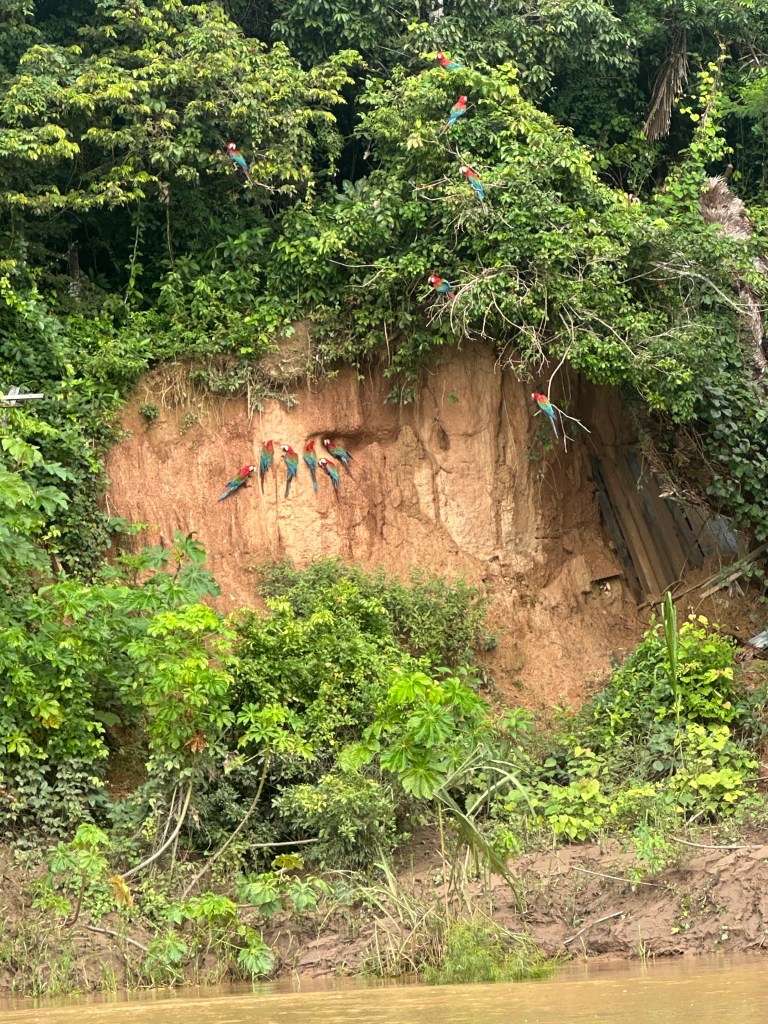
Carlos explained that the clay contains minerals that help neutralize toxins in the seeds and fruits the macaws eat. “It’s like their pharmacy,” he said with a smile. “And also their social club – look how they interact!”

We spent nearly two hours watching the incredible show, the birds squabbling, preening, and feeding on the mineral-rich clay. It was one of those experiences that photos simply can’t do justice – the colors, sounds, and sheer vibrance of life on display was overwhelming in the best possible way and immediately made the trip worth it. As I said last post, we are getting old and like birds now. 

After returning to the lodge for a late breakfast, we rested through the hottest part of the day. By this point, Nikki and I had both developed a permanent sheen of sweat that no amount of changing clothes could address. We’d long given up on looking presentable and embraced the jungle experience fully, grateful for each breeze that occasionally found its way through the thick vegetation.

Day 3: Oxbow Lake and Piranha Fishing

Our third day took us to a nearby oxbow lake – a crescent-shaped body of water formed when a river bend gets cut off from the main channel (fluvial geomorphologist here). We hiked about 45 minutes through dense forest to reach it, Carlos pointing out medicinal plants and fascinating insects along the way.

The lake itself was a perfect mirror, reflecting the surrounding jungle in its still waters. We boarded small wooden canoes and paddled silently around the perimeter, hoping to spot the giant river otters the lake was known for.

“They are very shy,” Carlos warned us. “We might not see them today.”

Despite our quiet approach and patient waiting at several promising spots, the otters remained elusive. But the lake had plenty of other wonders to offer. Titi monkeys chattered at us from the trees, their expressive faces curious and mildly annoyed at our presence. A group of squirrel monkeys crossed above us, using vines like highways in the sky. Birds were everywhere – from tiny kingfishers darting across the water’s surface to stately hoatzins with their prehistoric appearance perched in lakeside trees. 

After a picnic lunch on a small wooden platform, Carlos brought out fishing lines with simple hooks. “Now we fish for piranhas,” he announced casually.

He showed us how to bait the hooks with small chunks of raw meat and dangle them just below the water’s surface. Most of our group seemed more concerned with keeping their fingers far from the water than with actual fishing technique, but Nikki and I were determined to have the full experience. The most interesting part of the fishing was how voracious the piranhas were. We feel like movies usually over-exaggerate things like piranhas but as soon as the meat chunk hook hit the water, the water roiled as if boiling while 10 plus fish were nibbled at the meat. We quickly learned the hard part was not getting a fish attracted, like in fly fishing, but waiting for a bit enough bite that would actually try to eat the whole chunk of meat instead of just nibbling at its edges.

Our persistence paid off. After about twenty minutes of patient baiting and rebaiting, I felt a sharp tug on my line. With a quick jerk (as Carlos had demonstrated), I pulled up a small but unmistakable red-bellied piranha, its razor-sharp teeth gnashing as it dangled from my hook.
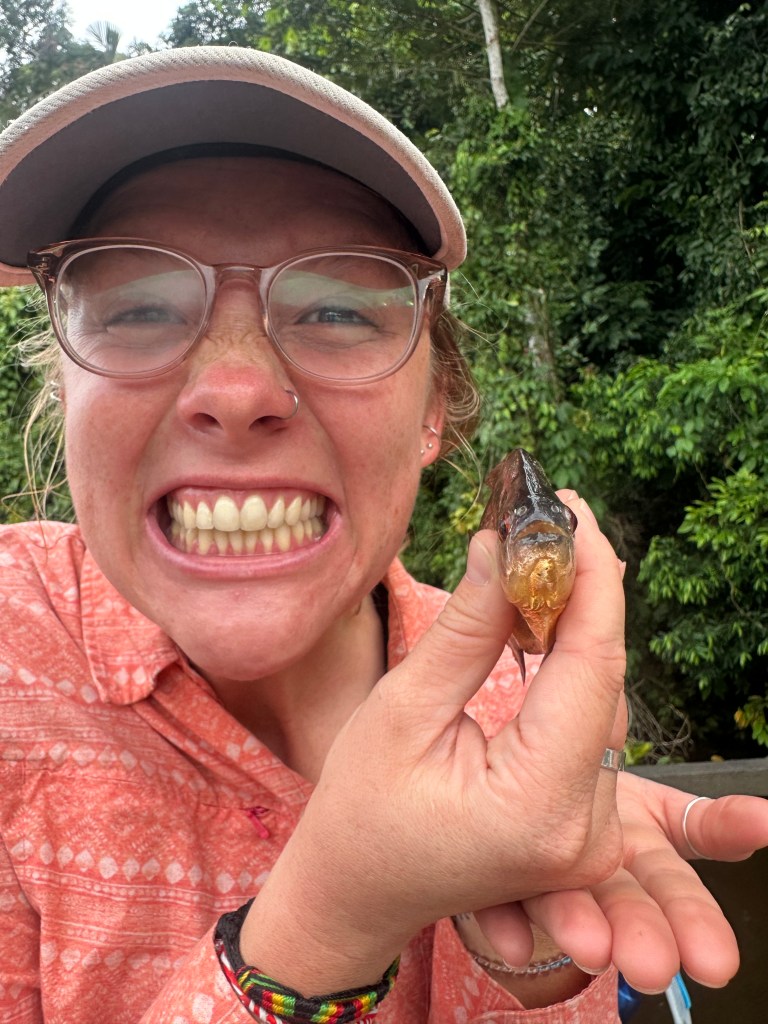
“Don’t put your fingers near the mouth!” Carlos warned unnecessarily – the fish’s fearsome reputation and visible dental equipment were warning enough.

Not to be outdone, Nikki caught one shortly after, hers slightly larger than mine. We were the only ones in our group to catch anything, which earned us congratulatory nods from Carlos and slightly envious looks from the others. I felt like a proud son as my dad had taught me to fly fish at a young age and Nikki and I being the only ones to actually land a fish made for a great story to tell him afterwards. After examining our catches up close (from a safe distance), we released them back into the lake.

Day 4: Return to Civilization

Our final morning in the jungle began with a chorus of howler monkeys that served as our wilderness alarm clock. After one last breakfast at the lodge, we packed our now slightly damp belongings and prepared for the journey back to Puerto Maldonado. The downriver trip was faster than our journey up, the current carrying us along as we took in final views of the magnificent rainforest.
As Puerto Maldonado came into view, I felt a curious mix of emotions. Part of me longed for the relative comfort of our camper – for dry clothes, for a break from the relentless humidity and the armies of mosquitoes that had feasted on us despite liberal applications of repellent. But another part felt reluctant to leave this incredible world behind, a place so vibrant with life that every moment offered something new to discover.

When we finally reached our camper, we cranked up the roof vents to their highest setting and spread our damp clothes everywhere to dry. Looking at Nikki, her hair a wild mess of humidity-induced curls and her arms dotted with bug bites that matched my own, we both burst out laughing.

“I think I’ve sweated out every ounce of water I’ve consumed in the past four days,” she said, guzzling from our water bottle.

“Worth it?” I asked, already knowing the answer.

“Absolutely worth it,” she confirmed. “But maybe next stop somewhere with air conditioning?”

As we settled back into loving home, we knew the Tambopata experience would remain one of the highlights of our South American adventure. From the soaring condors of Colca Canyon to the chattering monkeys of the Amazon, this continent continued to amaze us with its incredible diversity. Five months in, and we were still discovering new worlds within this remarkable land.
Crossing into Peru: Arequipa to Puerto Maldonado

After our altiplano adventures in northern Chile’s remote national parks, Nikki and I were ready to move northward and cross into Peru, a country we’d both been looking forward to since planning our overlanding journey. The border crossing from Chile to Peru was next on our list, along with exploring the culturally rich city of Arequipa, the dramatic depths of Colca Canyon, and the steaming geysers that dot the volcanic landscape.

The border crossing was relatively straightforward but not quick. We arrived early in the morning hoping to beat any crowds, but found ourselves in a line of vehicles already waiting for processing. The Chilean exit procedures went smoothly, and then we drove the short distance to the Peruvian entry point.

“Stamp number four in the passport for this trip,” Nikki said as we finally pulled away from the border. The entire process had taken about three hours, which honestly wasn’t bad compared to some stories we’d heard from other overlanders. The road ahead beckoned, and Arequipa was our first destination in this new country.

The drive to Arequipa was beautiful, starting in a desolate desert at the border crossing to winding through highlands with distant volcanoes framing the horizon. As we approached the city, the magnificent El Misti volcano dominated the skyline, its perfect cone standing sentinel over what we would discover was one of Peru’s most charming cities.

After weeks of camping and basic accommodations in remote parts of Chile, we decided that Arequipa warranted a bit of a splurge. We found a charming boutique hotel in the historic center, complete with a courtyard and stone archways that spoke to the city’s colonial past.

“I think we’ve earned this,” I said as we dropped our bags in a room with an actual mattress instead of our truck’s sleeping platform. Nikki was already eyeing the shower, which promised hot water but to our dismay only spewed cold water. A nice hot shower is one of the hardest niceties to find on a trip like this. Unfortunately we are used to cold showers and took one anyways.

Refreshed and ready to explore, we spent our first day wandering the historic center of Arequipa, admiring the distinctive white volcanic sillar stone buildings that give the city its nickname, “The White City.” The Plaza de Armas was particularly stunning, with its cathedral and colonial architecture providing the perfect backdrop for people-watching.

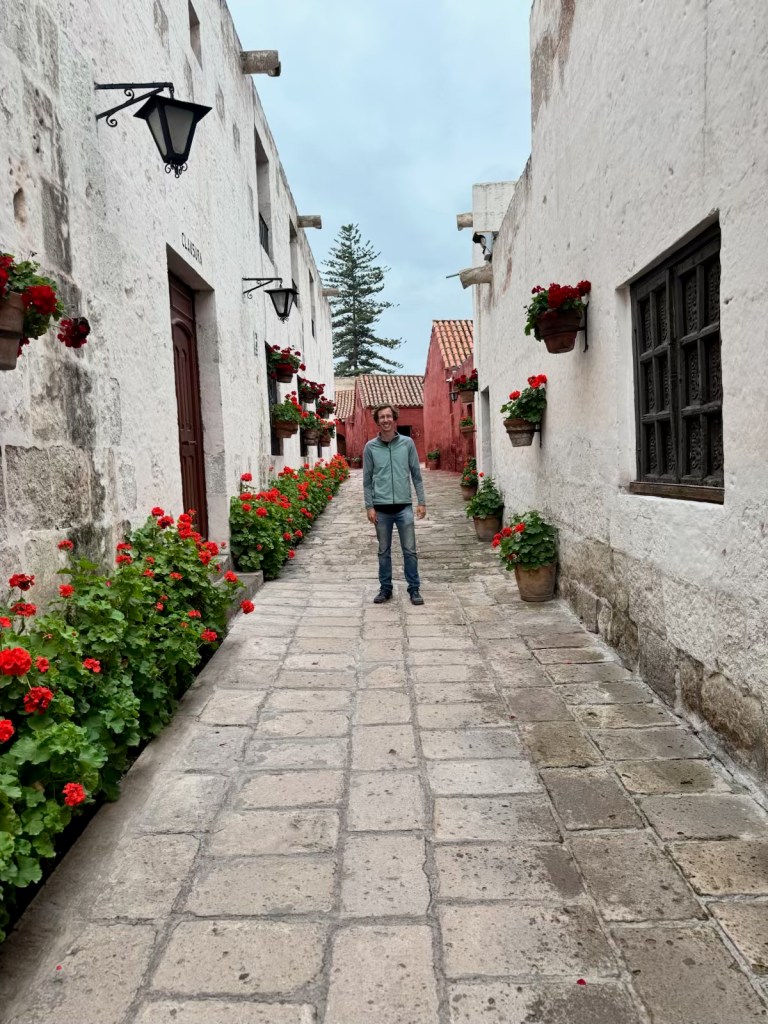
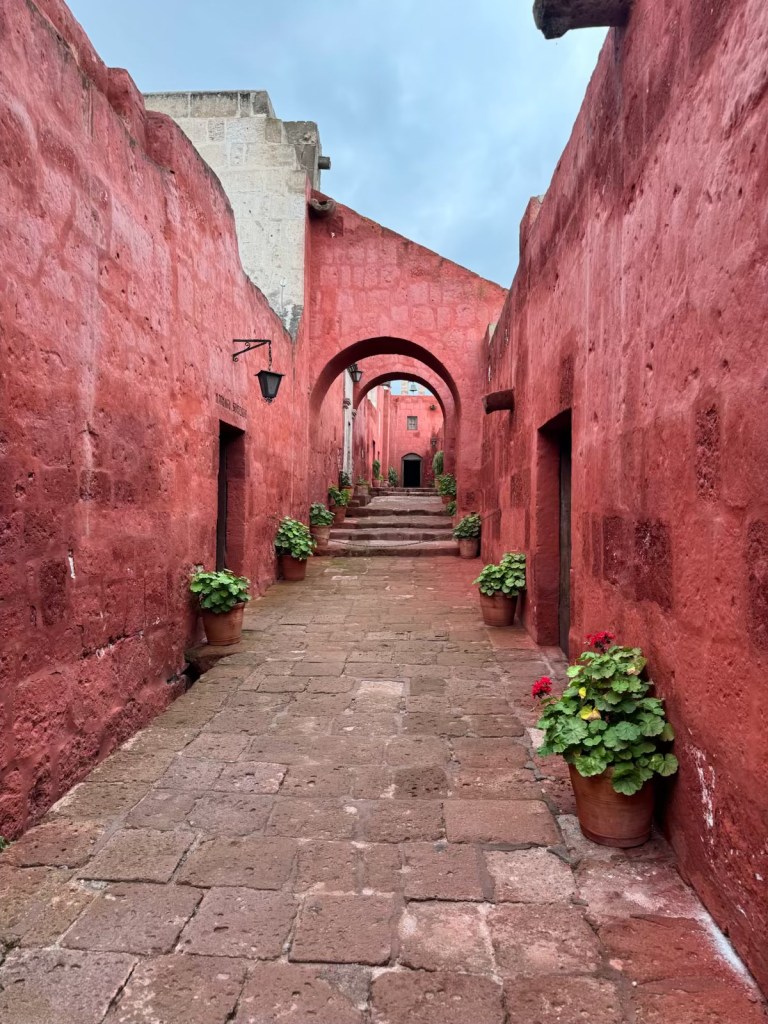
The highlight of our time in Arequipa was undoubtedly the Santa Catalina Monastery. This sprawling 20,000 square meter citadel in the heart of the city served as a cloister for Dominican nuns for over 400 years. Walking through its vibrant streets and cloisters painted in deep blues and terracotta reds felt like stepping back in time.

“It’s like a small city within the city,” Nikki remarked as we wandered through the maze of tiny streets, each named after Spanish cities. The nuns who lived here were primarily from wealthy Spanish families, and many brought servants and luxurious possessions with them when they entered the convent. Our guide explained how each nun had her own quarters, some quite elaborate, which contrasted sharply with our modern image of simplistic monastic life.

The monastery provided fascinating glimpses into the daily lives of these women – from the communal kitchens with their massive clay ovens to the washing stones where laundry was done, to the silent cloisters where they would meditate. We spent hours exploring, captivated by this hidden world and trying to image what life was like back then.

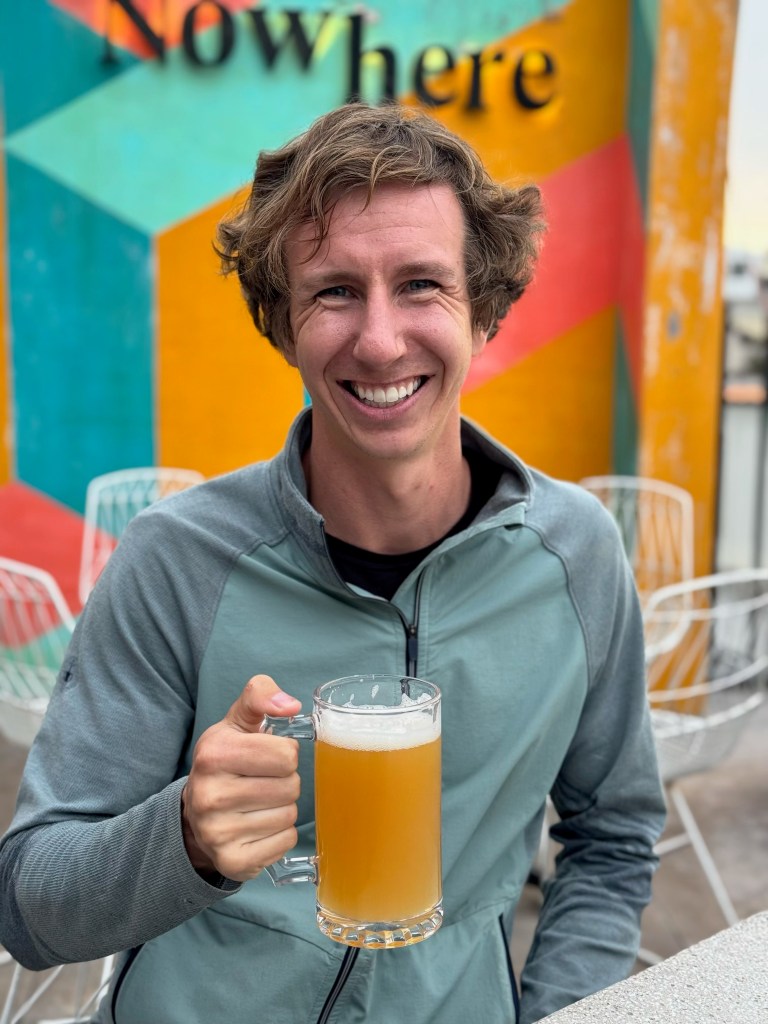
After all that history and culture, we were ready for something a bit more familiar – good craft beer. A quick search led us to Nowhere Brewery, which immediately felt like a little slice of home. The industrial-chic taproom could have been plucked straight from Pittsburgh or Denver, and the beer list featured hoppy IPAs and rich stouts that reminded us of our favorite breweries back home.

“This tastes just like that double IPA from Dancing Gnome,” Nikki said after her first sip, referring to one of our favorite Pittsburgh breweries. I agreed, already eying the bourbon barrel-aged stout that was next on our tasting flight. We ended up spending the evening chatting with the owners, who wanted to know where we were from and what the beer was like there. We told him his beer stood up to some of favorites in the United States. The beer culture in South America is very different than in the States. Usually each country has 2 to 3 standard pilsners or lagers, which usually are pretty good, but thats where the variety ends. Since our last trip in 2020, we have noticed a small change though. We have found a few places like Nowhere Brewery that are bringing new beer varieties to South America.

After three lovely days in Arequipa, we were ready to get back on the road and explore the natural wonders of the region. First stop: Colca Canyon, one of the world’s deepest canyons at twice the depth of the Grand Canyon.

The drive to Colca took us through high mountain passes where vicuñas grazed against a backdrop of volcanoes. We stopped at the highest point, Patapampa Pass at 4,910 meters (16,109 feet), where even with our experience with high elevation, even walking a few hundred feet took our breath away. The view of the surrounding volcanic peaks more than made up for the lightheadedness.

We arrived at the canyon rim in the afternoon and made our way to the famous Cruz del Condor viewpoint, hoping to catch a glimpse of the massive Andean condors that ride the thermal updrafts from the canyon depths each day. We weren’t disappointed – within minutes of arriving, we spotted our first condor soaring below us before rising on an air current to eye level. By sunset, we’d seen at least a dozen of these impressive birds, some flying close enough that we could hear the wind through their massive wing feathers. We can tell we are maturing, or just plain getting older, due to our new interest in birds.

“I can’t believe how huge they are,” Nikki whispered as one particularly large condor glided past, its wingspan easily reaching over 10 feet.

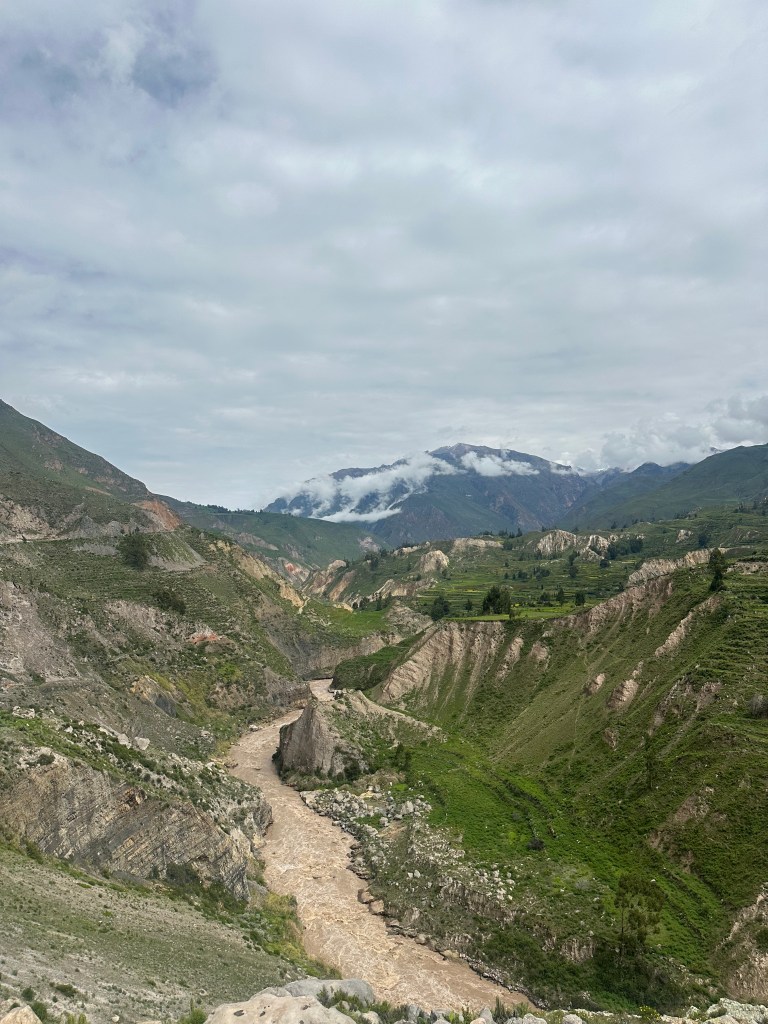
The next morning, we embarked on what would be one of the most physically challenging, short hikes of our trip – a two-day trek to the bottom of Colca Canyon. With our daypacks filled with essentials (and our truck securely parked in a guarded lot), we began the steep descent into the canyon. The trail wound back and forth down the canyon wall, offering increasingly spectacular views of the river cutting through the landscape far below.

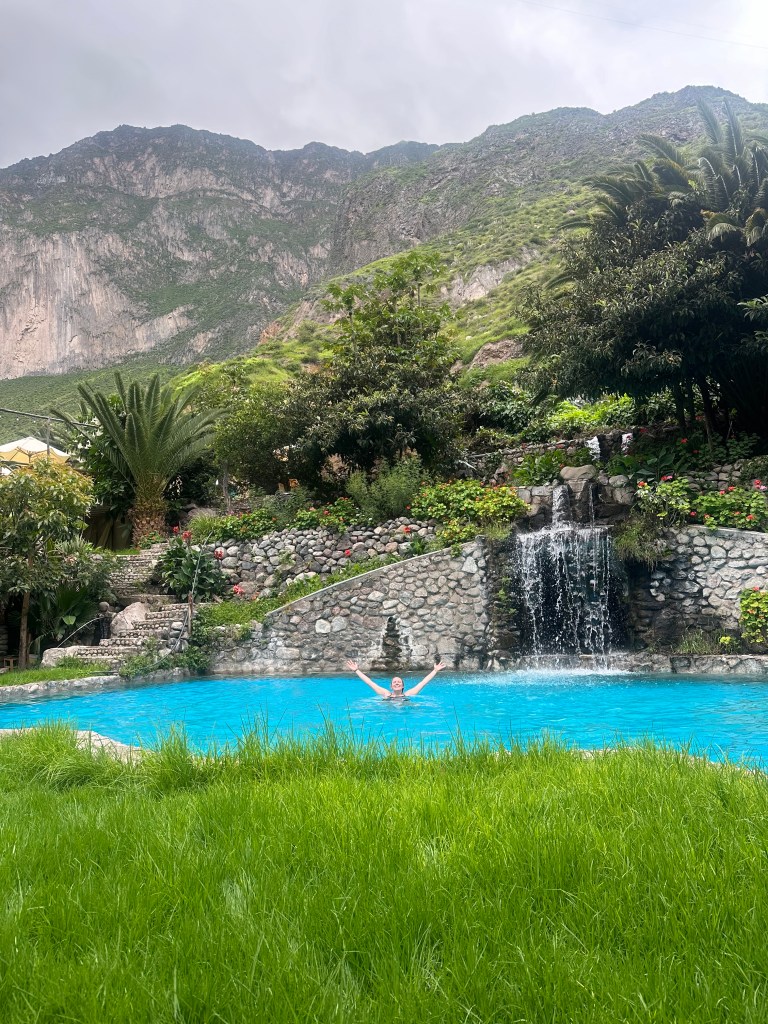
After about 3 hours of downhill hiking (which is harder on the knees than you might expect), we reached our destination – an oasis of palm trees and greenery nestled at the bottom of the canyon. The small settlement of Sangalle offered basic accommodations, but the real draw was the naturally fed swimming pool, its clear blue water a welcome sight after the dusty trail.

We spent the remainder of that day lounging by and swimming in the pool, marveling at how this lush paradise could exist surrounded by such arid canyon walls. The contrast between the barren rocky slopes and the verdant oasis created by the river’s presence was striking.

We floated in the cool water for hours, looking up at the sliver of sky visible between the towering canyon walls. But we knew the climb out awaited us, and it would be a challenging one.

The hike back up to the canyon rim the next day was every bit as difficult as we’d anticipated. Starting before dawn to avoid the worst of the heat, we slowly made our way up the switchbacking trail, gaining over 1,000 meters of elevation in just a few hours. The views provided welcome excuses to stop and catch our breath, and by mid-morning, we had reached the top, tired but triumphant.

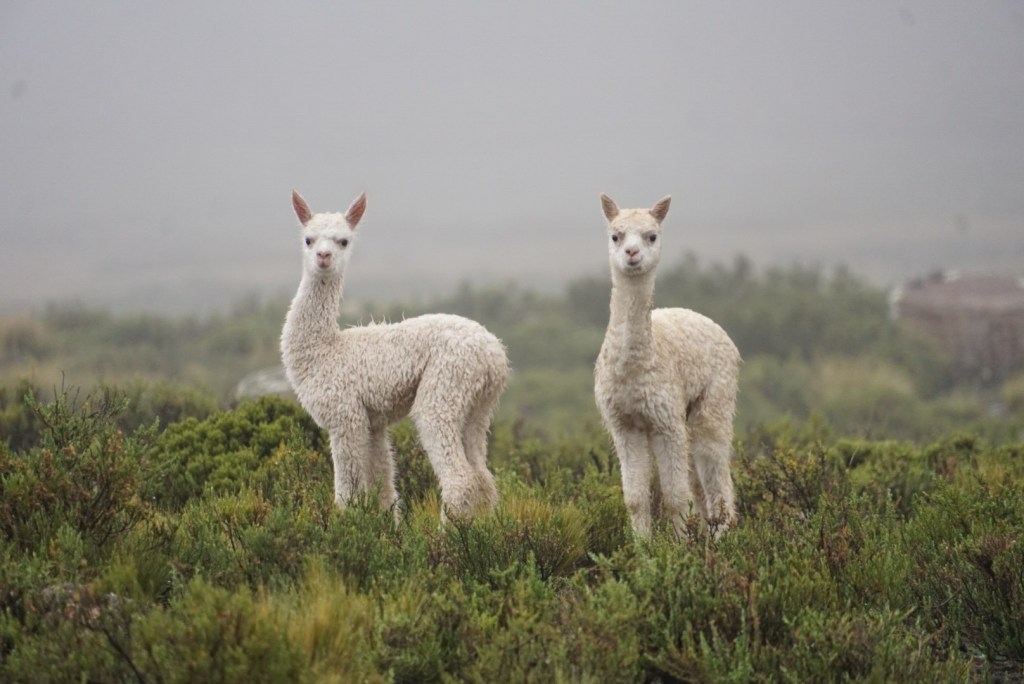
After recovering from our canyon adventure, we continued our journey toward the Valley of the Geysers, another natural wonder that had long been on our list. The drive took us through remote highlands where llamas outnumbered people, and finally to a valley where steam rose from the earth in dozens of places – a clear sign we’d arrived.

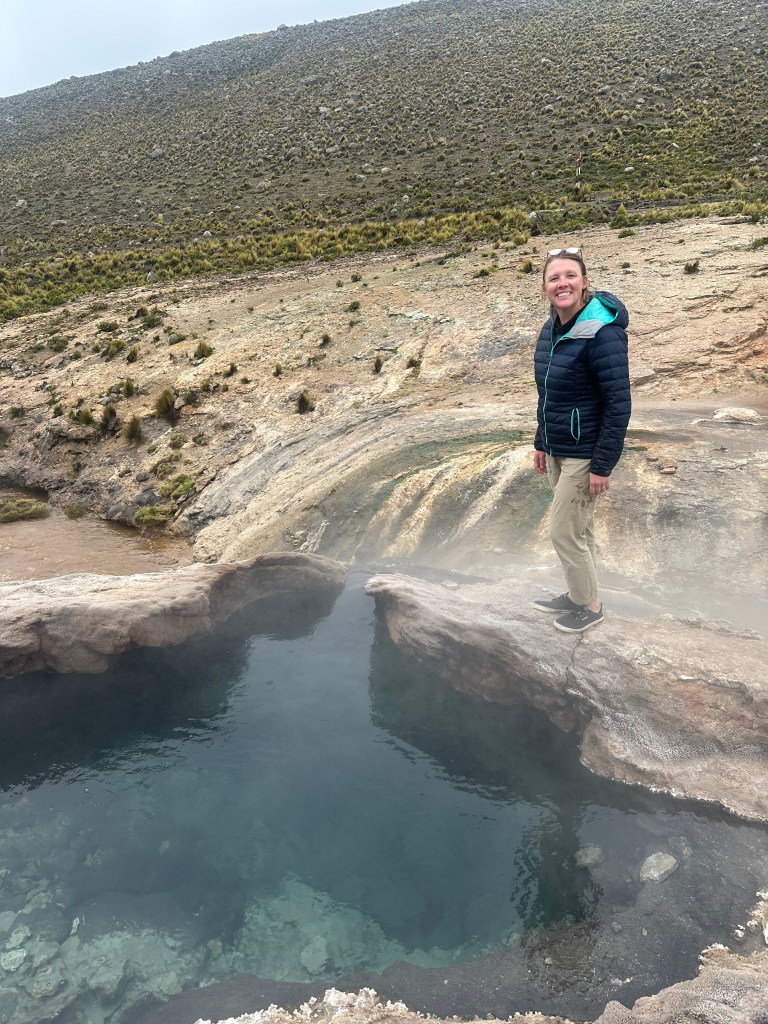
The Valley of the Geysers was unlike anything we’d seen before – over 80 active geothermal features spread across a lunar-like landscape. We spent hours walking among steaming fumaroles, bubbling mud pots, and geysers that erupted with impressive regularity. The smell of sulfur hung in the air, and the ground felt warm beneath our feet. The highlight was the Olla del Diablo (Hole of the Devil), which was a crystal clear 10 foot deep pool of boiling water. We both stood on the rim of the pool and lost ourselves in the mesmerizing rolling bubbles of perfectly clear water. We both felt a slight pull of the “devil” tempting us to jump in.

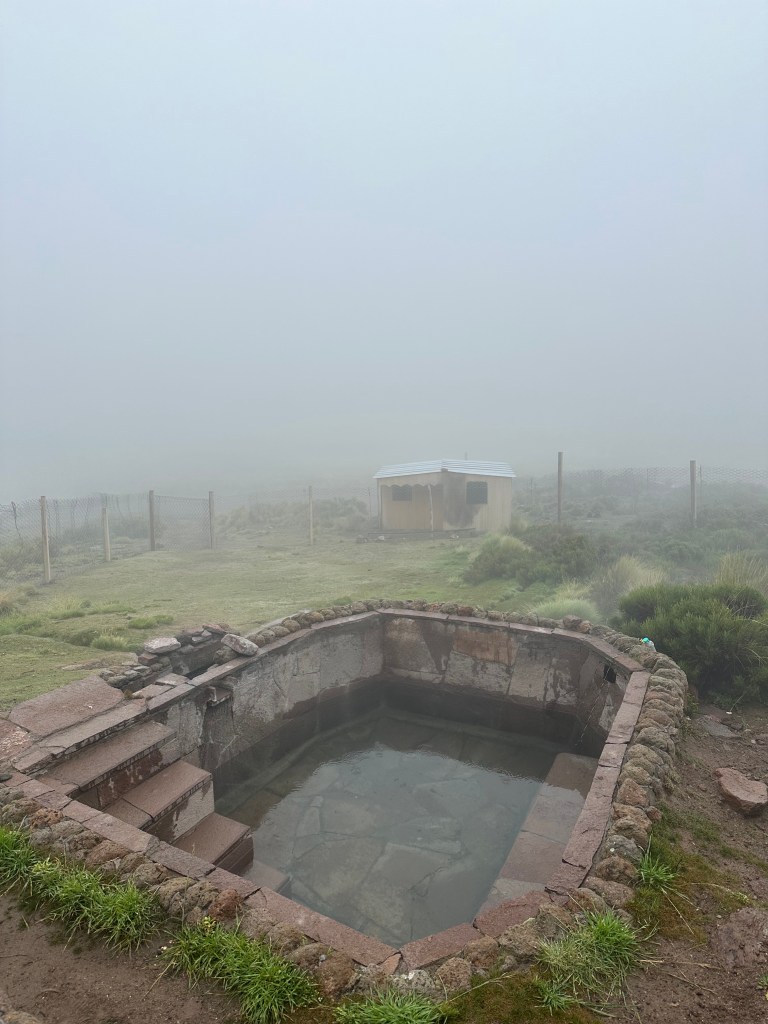
Another memorable part came as evening approached, and we made our way to the natural hot springs at the edge of the geyser field. Unlike the developed hot springs we’d visited elsewhere, these were simple rock-lined pools where you could divert water from a nearby hotpot to fill the pool with water to your liking all with views of the steaming valley. We soaked our tired muscles as the sun set, turning the sky pink and orange above the volcanic landscape.

That night, camping near the springs, we experienced one of our most memorable nights. A low fog crept into the valley giving us the feeling of being one of the last people on Earth. The occasional distant apocalyptic like rumble and hiss of geysers provided a reminder of the living earth beneath us.

Our next destination was Puerto Maldonado, a gateway to the Amazon basin that would mark a significant change from the highland landscapes we’d been traveling through. The drive was long but fascinating, as we descended from the heights of the Andes into the beginnings of the Amazon.

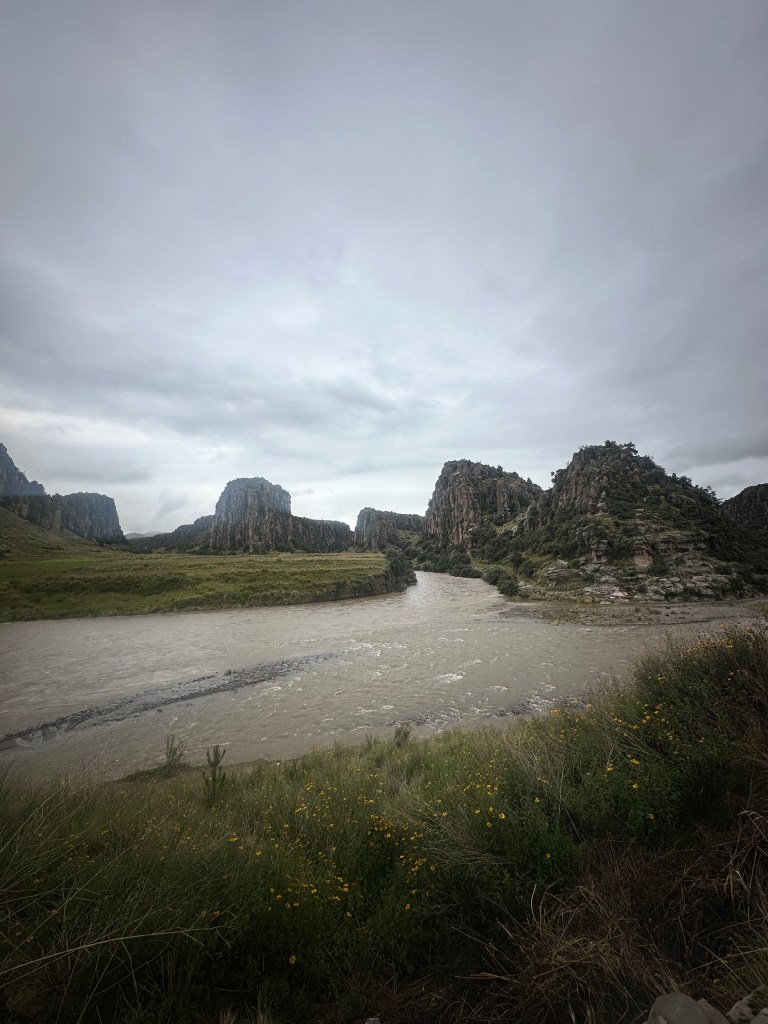
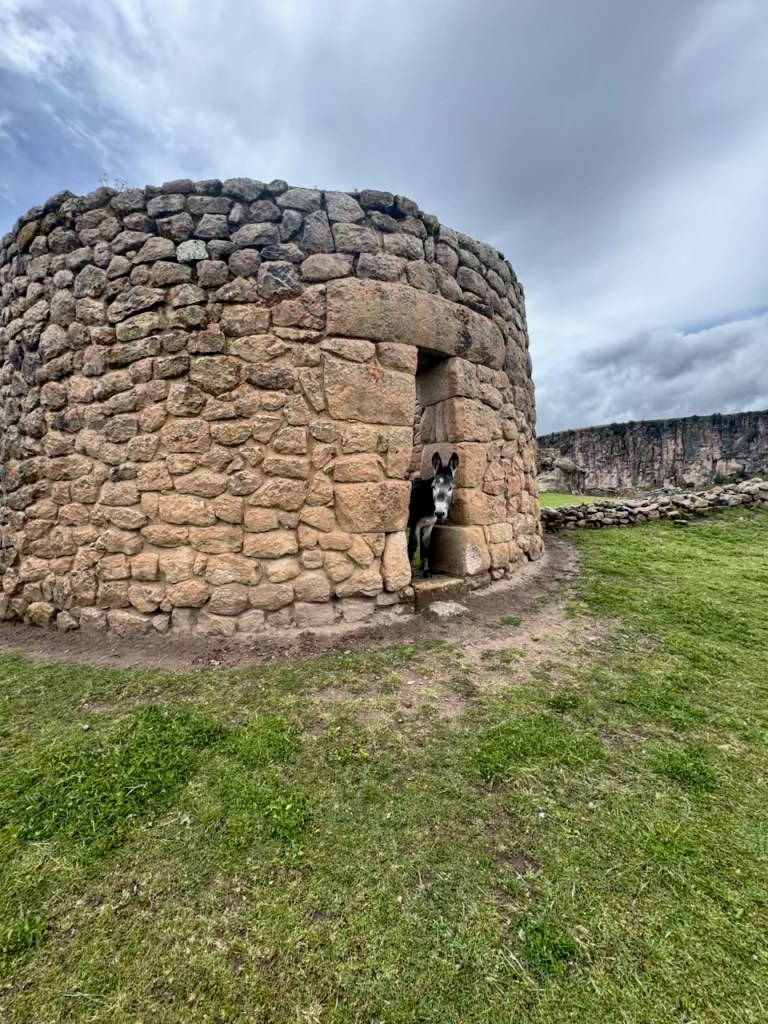
Along the way, we made a detour to visit a lesser-known archaeological site perched on a ridge overlooking what’s known as Tres Cañones – three dramatic canyons carved by rivers converging in a spectacular landscape. The pre-Incan ruins were not as restored or famous as others in Peru, but their dramatic setting made them special.

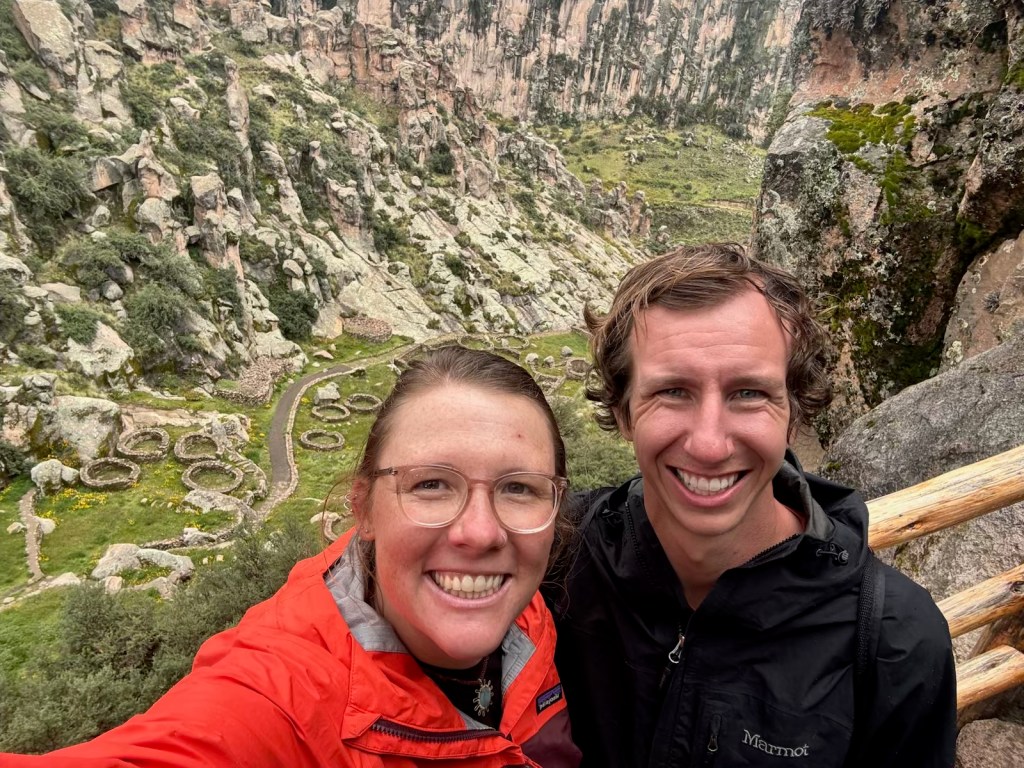
“Can you imagine living here and waking up to this view every day?” Nikki asked as we stood on ancient stones looking out over the vast canyons. We spent several hours exploring the ruins and hiking along the canyon rim, marveling at how the ancient builders had chosen such a spectacular and strategic location. This pre-Incan site had just been restored and opened to the public in 2024 so we felt very privileged to be some of the first people to tour it.

As we continued our descent toward Puerto Maldonado, the landscape transformed dramatically – alpine scrub gave way to cloud forest, which gradually became lusher and more tropical as we lost elevation. The temperature rose, and the biodiversity increased noticeably with each passing hour.

By the time we reached Puerto Maldonado, we had descended from the cold, thin air of the altiplano to the humid warmth of the Amazon basin. Our truck, which had performed admirably on high mountain passes and remote desert tracks, now found itself on muddy jungle roads – a new challenge for the next leg of our journey.

Looking back on this segment of our overlanding adventure – from the White City of Arequipa to the depths of Colca Canyon, from steaming geysers to ancient ruins – we were struck by the incredible diversity of landscapes and experiences Peru had already offered us. And with the Amazon jungle now before us, we knew the adventures were only beginning.

Our truck’s back bumper, still held together with duct tape and stickers from our altiplano mishap in Chile, had become something of a conversation starter at border crossings and gas stations. “We’ll get it fixed properly back in the States,” we kept saying. But truth be told, it had become a badge of honor – tangible evidence of the roads less traveled that had brought us to this point in our journey.

Vicuñas and Lauca: The Remote Altiplano

Nikki and I stood at the edge of the vast salt flat, watching as the morning light transformed the stark white plain into a shimmering mirror. Our truck was parked about 100 yards back, our home on wheels looking particularly small against the enormity of Chile’s northern altiplano landscape. After two incredible weeks exploring the Mars-like landscapes of San Pedro de Atacama and the otherworldly expanses of Bolivia’s Salar de Uyuni, we were eager to venture further into the remote wilderness of northern Chile. The extreme altitudes and untamed beauty of Vicuñas and Lauca National Parks were calling to us, promising experiences far from the tourist trail.

The decision to venture into this remote part of Chile wasn’t made lightly. The northern altiplano sits entirely above 14,000 feet and gas is hard to come by. But after seeing the incredible salt flats of Uyuni, we were hungry for more of these unique high-altitude ecosystems. Our overlanding journey through South America was about seeking these less-traveled paths, about finding beauty in places where few venture.

Our journey to the altiplano began on what the map optimistically called a “road” but was more accurately a faint suggestion of tire tracks meandering through donkey filled landscape. We had spent hours studying the route on iOverlander and Maps.Me to find this road that would connect Lauca and Vicuñas national park. With 40 liters of extra gas and full on other supplies 3, we left the last significant town behind knowing that we would be on our own for the next few days.

The drive was every bit as challenging as we had anticipated. The tracks wound their way higher and higher into the mountains, sometimes disappearing completely and leaving us to navigate by sight and instinct. It was both thrilling and a little intimidating about being so far from civilization, where a wrong turn or mechanical failure could mean serious trouble. We did come across a another car that was stuck in a sandy river bottom. They had been there for 7 hours and thankfully for them, we were able to tow them out of the sand and send them back on their way they came. We thanked Tony the Tacoma for his off-roading capability as we cruised across the river valley to our campsite on the other side.

On our second day of off-roading, we encountered a stream crossing that looked innocuous enough from a distance but revealed its true nature as we approached. The banks were steep, and the bottom was littered with rocks that threatened to catch our undercarriage.

“I think we can make it,” I said with more confidence than I felt. “Just need the right angle.” I did think the crossing was doable but I may have been influenced by not wanting to turn back and redo the 10 hours of off-roading we had just completed when we were only 5 km from the paved main road.

I carefully lined up the truck and started the descent toward the stream. We were about halfway through the crossing when we heard it—that sickening crunch of metal meeting rock. Our back bumper had caught on a boulder as we climbed out of the stream bed, and the sound of tearing plastic told us this wasn’t going to be a quick fix.

After carefully extracting ourselves from the situation, we assessed the damage. Our back bumper was partially torn away, hanging at an awkward angle and scraping the ground but we made it through the crossing. With some duct tape and a bit of ingenuity, we managed to secure it well enough to continue, but it was a stark reminder of how isolated we were. This wasn’t like breaking down near Temuco where we could find a shop with a line out the door; out here, we were truly on our own.

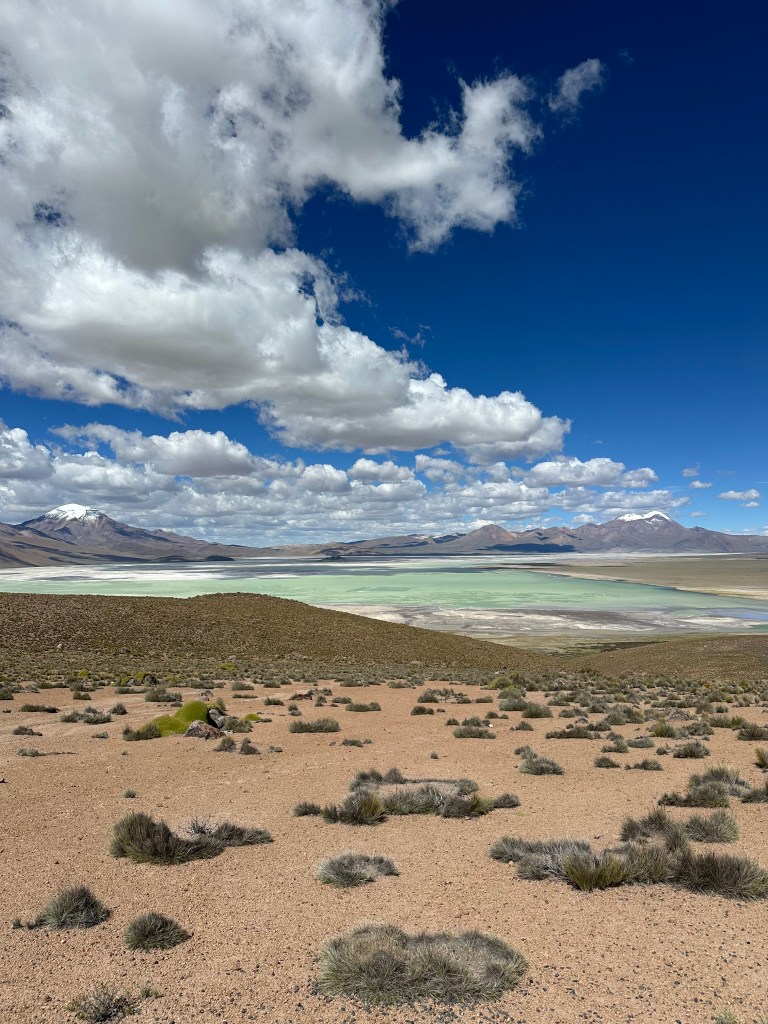
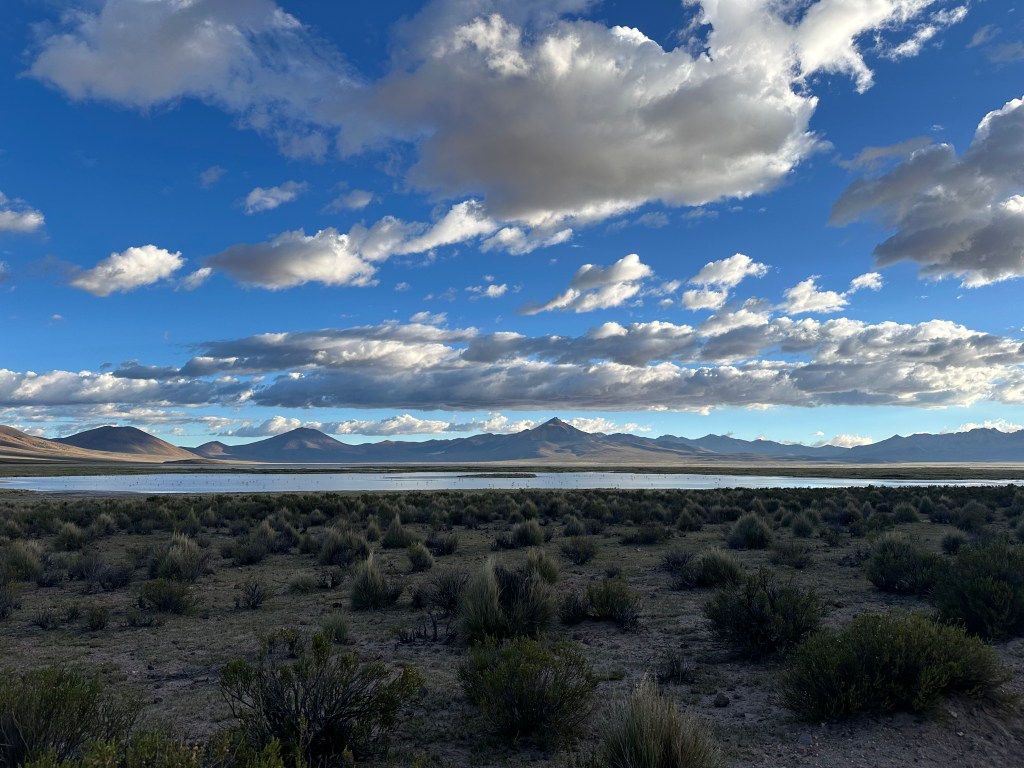
Despite the bumper mishap, our spirits remained high as we finally entered Vicuñas National Park. The landscape opened up before us into a vast plateau dotted with lakes and marshes—perfect habitats for the flamingos we had been hoping to see. And there they were, dozens of them, their pink bodies creating a stunning contrast against the blue of the high-altitude lakes.

“I still can’t believe we’re seeing flamingos at 14,000 feet,” Nikki marveled as we watched them filter feed in the mineral-rich waters. “It feels like we’re on another planet.” We traversed around the expansive salt flat to arrive at a remote hot spring, which are one of our favorite things on this trip!

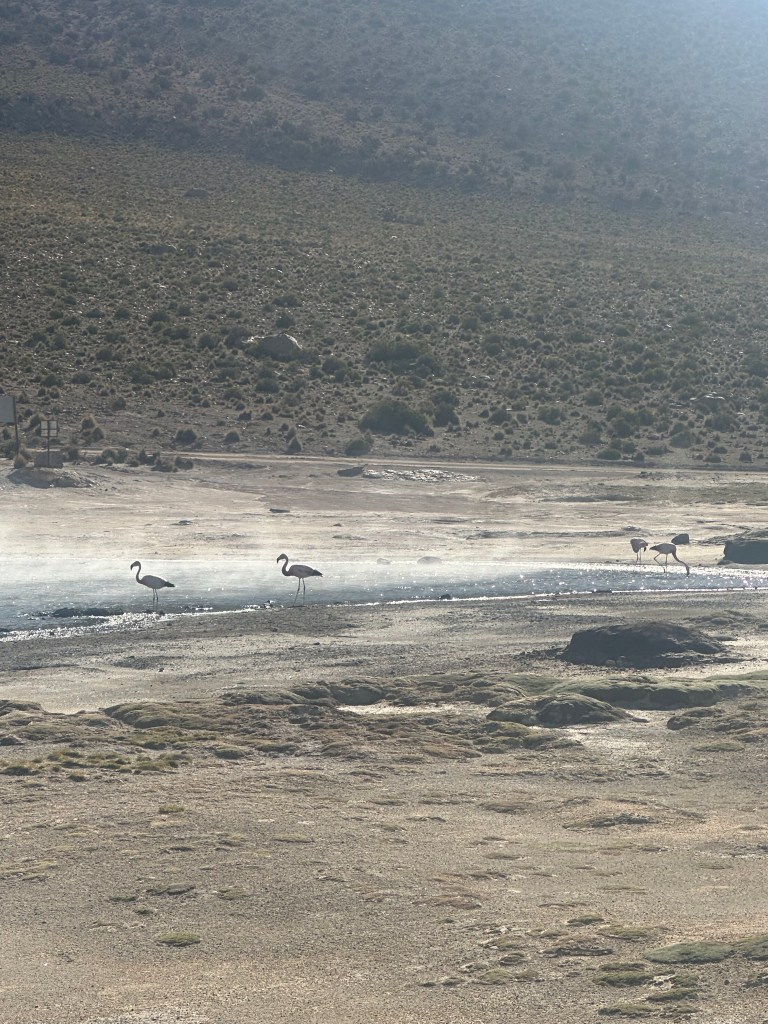
The hot spring was the perfect antidote to the chilly altiplano air, and we quickly changed into swimsuits and slipped into the warm, mineral-rich water. As we soaked, taking in the panoramic views, Nikki suddenly grabbed my arm and pointed. Just about fifty yards away, a group of flamingos had landed at the edge of a neighboring pool, apparently undisturbed by our presence. We watched in amazed silence as they went about their business, occasionally dipping their beaks into the water or preening their feathers.

“This has to be one of the most surreal experiences of my life,” Nikki whispered, not wanting to disturb our pink neighbors. “Soaking in a hot spring at 14,000 feet while watching flamingos.”

We stayed in the hot spring until our fingers pruned, sharing the space with our flamingo friends who seemed completely unconcerned with our presence. It was one of those rare moments of perfect communion with nature that make all the hardships of overlanding—the broken bumpers, the challenging routes, the uncertainty—completely worth it.

We found a perfect camping spot after the hot spring with a view of both the flamingo-filled lake and a nearby volcano. That night, we slept under one of the clearest night skies I have ever seen, with the Milky Way stretching from horizon to horizon in breathtaking detail. The silence was profound—no distant traffic, no airplanes overhead, just the occasional call of a bird and the whisper of wind across the altiplano.

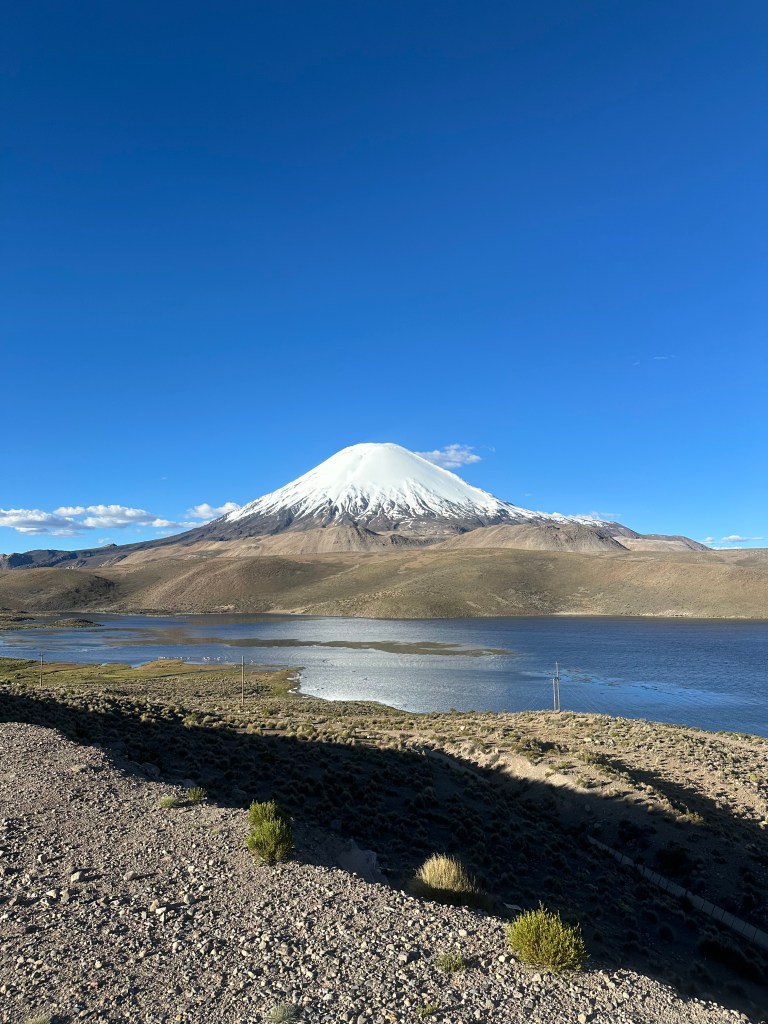
The next morning, we continued our journey to Lauca National Park, driving through landscapes that seemed to belong in a nature documentary rather than real life. The twin peaks of Volcán Parinacota and Volcán Pomerape dominated the horizon, their perfect cones reflecting in the mirror-like surface of Lake Chungará. We stopped to take in the view, both of us speechless at the beauty before us.

We decided to stop at the ranger station to get information about hiking trails and camping spots. The ranger, Carlos, seemed genuinely surprised to see visitors in this remote section of the park.

“Not many people come this way,” he told us in Spanish, his eyes crinkling with a smile. “Most tourists stay on the main road. You are adventurous!”

We chatted with Carlos for almost an hour, learning about the unique ecosystem of the park and the efforts to protect the vicuñas and other wildlife from poaching. He pointed us toward a few unmarked viewpoints that weren’t on any maps and gave us tips on the best spots to observe wildlife.

We spent three more days exploring Lauca National Park, hiking to viewpoints that offered expansive vistas of the altiplano, observing more vicuñas and even catching sight of the elusive Andean fox. Each night, we camped in solitude, not seeing another human for our entire stay except for Carlos at the ranger station.

On our last morning in Lauca, we woke early to watch the sunrise over Volcán Parinacota. As the first light hit the snow-capped peak, turning it a soft pink, we reflected on our journey through this remote corner of Chile. The broken back bumper (now held together with even more duct tape and a growing collection of stickers to hide the damage) was a small price to pay for the experiences we had gathered.

As we prepared to leave the altiplano and head back to more populated areas, I thought about how this journey had epitomized what overlanding is all about for us—seeking out those places that test your vehicle and your spirit, but reward you with experiences few others will ever have. After the salt flats of Uyuni and the red deserts of San Pedro de Atacama, the remote beauty of Vicuñas and Lauca National Parks had offered us yet another face of the incredible Andean highlands.

With one last look at the magnificent landscape and our last destination in Chile, we climbed into our truck and began the long descent back to civilization, already planning our next adventure, crossing into Peru!

Bolivia and Salar de Uyuni

After recovering from our unfortunate bout of food poisoning in San Pedro de Atacama, Nikki and I faced a difficult decision. We wanted to explore the famous salt flats and high-altitude lagoons of Bolivia, but we had heard about gas shortages in Bolivia which would make the remote driving more stressful. Even though the idea of driving Take on the salt pans was tempting, we also had to think of the potential long term damage from all the salt corrosion. In the end we decided to leave our beloved Taka securely parked in San Pedro and join a 4-day tour into Bolivia.

Finding secure parking for Taka was our first priority. Thankfully, iOverlander had a great recommendation of a secure parking lot where several other overlanders had left their vehicles while taking similar tours. With Taka safely tucked away and our essentials packed into small backpacks, we joined six other travelers and our Bolivian guide, Eduardo, in a well-worn 4×4 Toyota Land Cruiser.

The border crossing into Bolivia was a study in contrasts – the sleek, modern Chilean border post followed by the much more rustic Bolivian immigration office. After getting our passports stamped and exchanging some Chilean pesos for Bolivian bolivianos, we began our ascent into the high Altiplano, quickly climbing above 14,000 feet as we entered our first National Park in Bolivia.

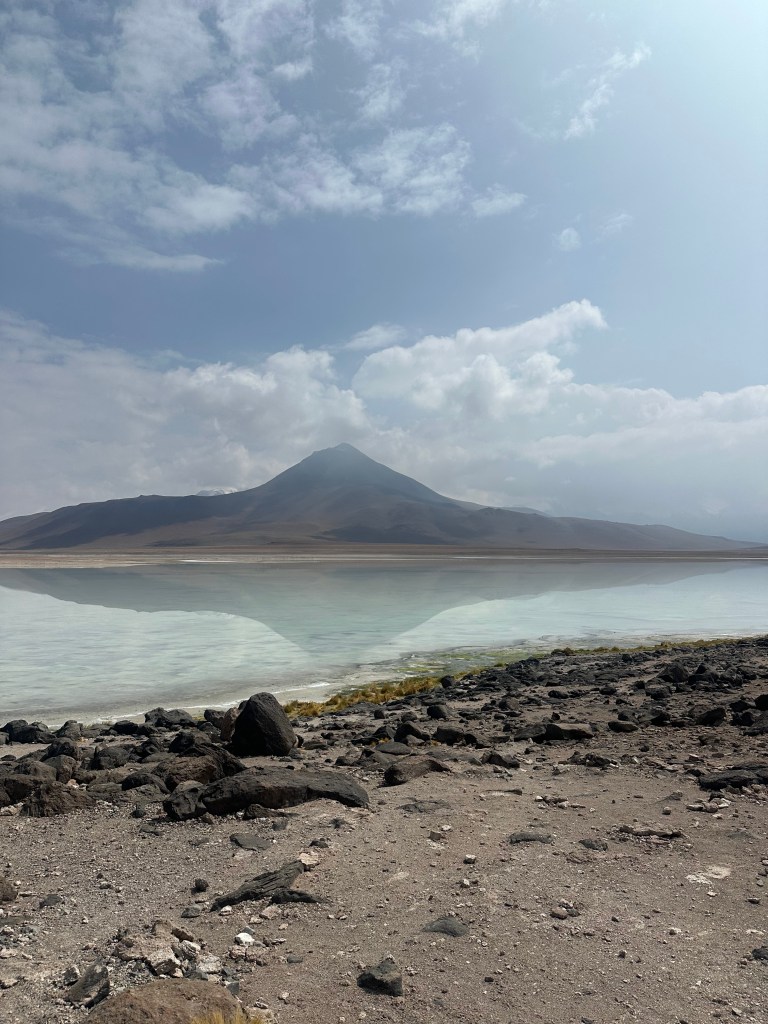
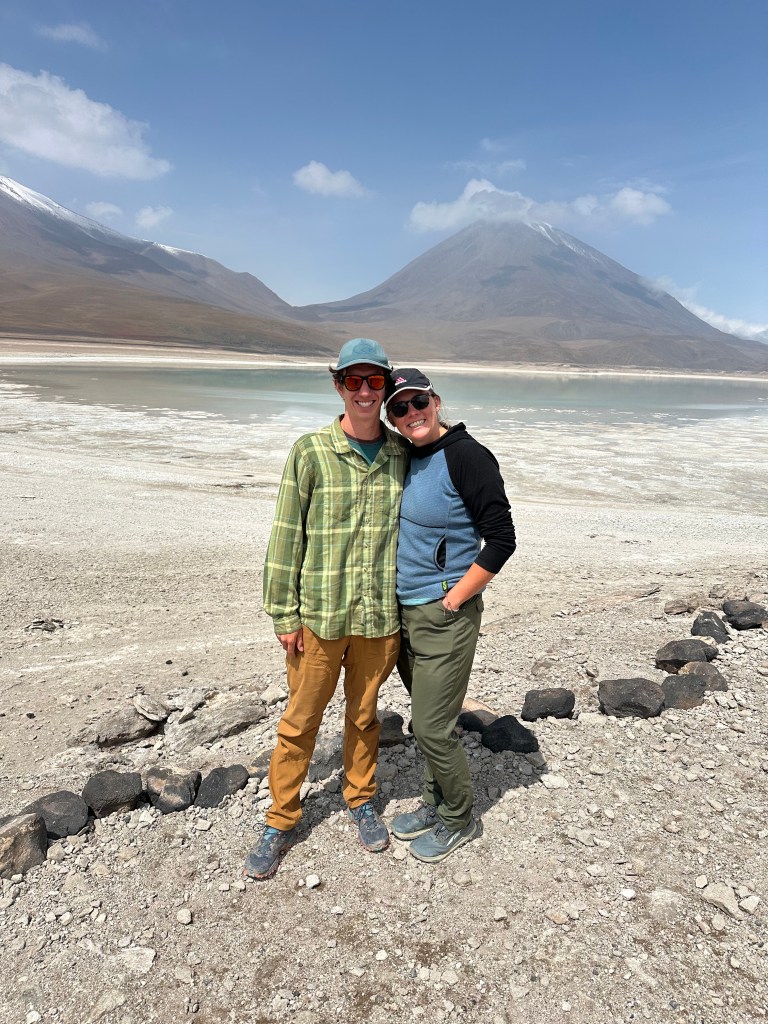
Our first major stop was Laguna Blanca, an otherworldly white salt lake that sits at the base of not one but two massive 6,000-meter volcanoes. As we stepped out of the Land Cruiser, the cold air hit our lungs, but the view instantly made us forget any discomfort. The lake’s surface was a brilliant white, reflecting the perfect cones of the volcanoes like a mirror. Eduardo told us that the white color comes from minerals suspended in the water – borax and other salts that create the milky appearance.

“Those volcanoes,” Eduardo said, pointing to the massive peaks, “mark the border between Bolivia and Chile. The one on the right is Licancabur, which you could see from San Pedro.” It was mind-boggling to think that just hours ago, we were looking at these same mountains from the opposite side. Small vicuñas grazed on the sparse vegetation around the lake, seemingly unaffected by the harsh conditions.

After Laguna Blanca, we continued our journey to what Eduardo called the “Salvador Dali Desert,” and it quickly became clear why. The landscape looked like it had been painted by the surrealist master himself with weird rock formations carved by wind erosion standing before us while in the distance, mountains in impossible shades of red, orange, and purple layered upon each other. The complete absence of vegetation made the scene even more surreal.

We spent our first night in a very basic hostel in a tiny settlement seemingly in the middle of nowhere. There was no heating, and the temperature dropped to well below freezing after sunset. Nikki and I huddled under mountains of blankets and were very grateful for the hot soup and tea that our hosts had prepared for dinner.

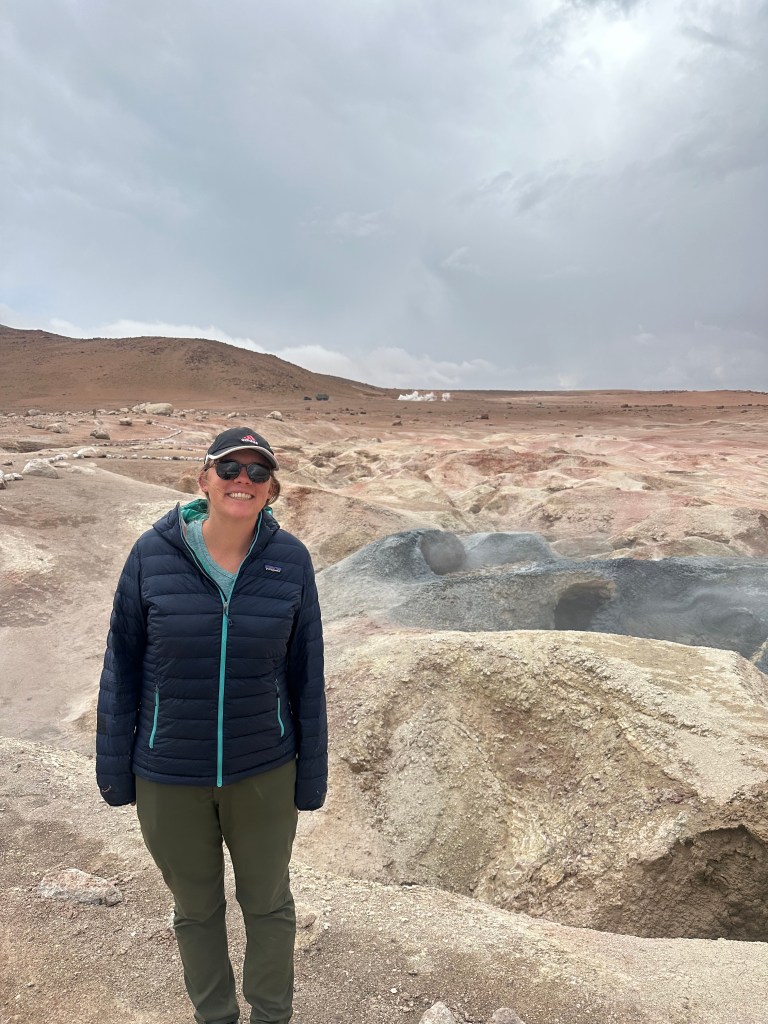
Dawn came early, and after a quick breakfast, we were back on the road, this time heading toward an active geyser field called Sol de Mañana (Morning Sun). As we approached, the smell of sulfur grew stronger, and soon we could see plumes of steam rising from the earth. The geysers weren’t the tall water spouts I had expected, but rather bubbling mud pots and steam vents that created an eerie, primordial landscape.

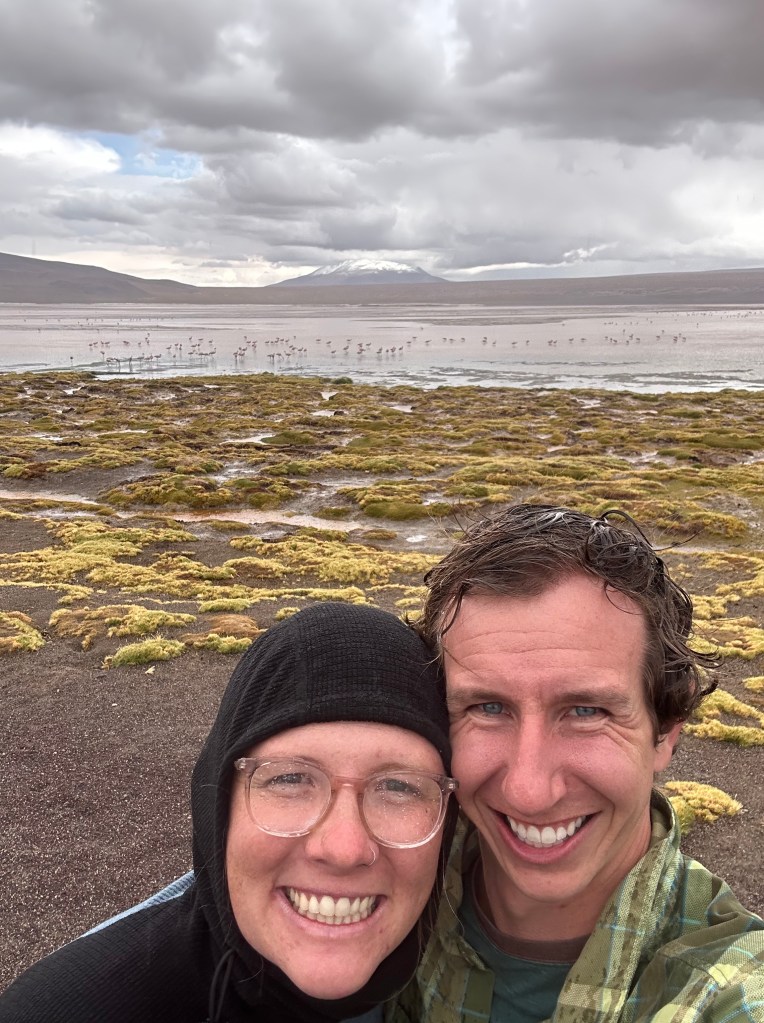
After exploring the geysers, Eduardo surprised us with a true highlight – a visit to natural hot springs with panoramic views over an altiplano lake. As we approached, we could see steam rising from a series of stone-lined pools built right at the edge of the lagoon. We changed into our swim suits and enjoyed relaxing in the hot springs with views of flamingos feeding in the lake and 19,000 foot volcanoes in the distance.

We soaked in the mineral-rich waters for over an hour, taking in the surreal beauty of our surroundings. The juxtaposition of being comfortably warm while gazing out at such a stark, challenging environment felt like the height of luxury. It was one of those perfect travel moments where you can’t quite believe where you are and you just have to sink into yourself to appreciate life.

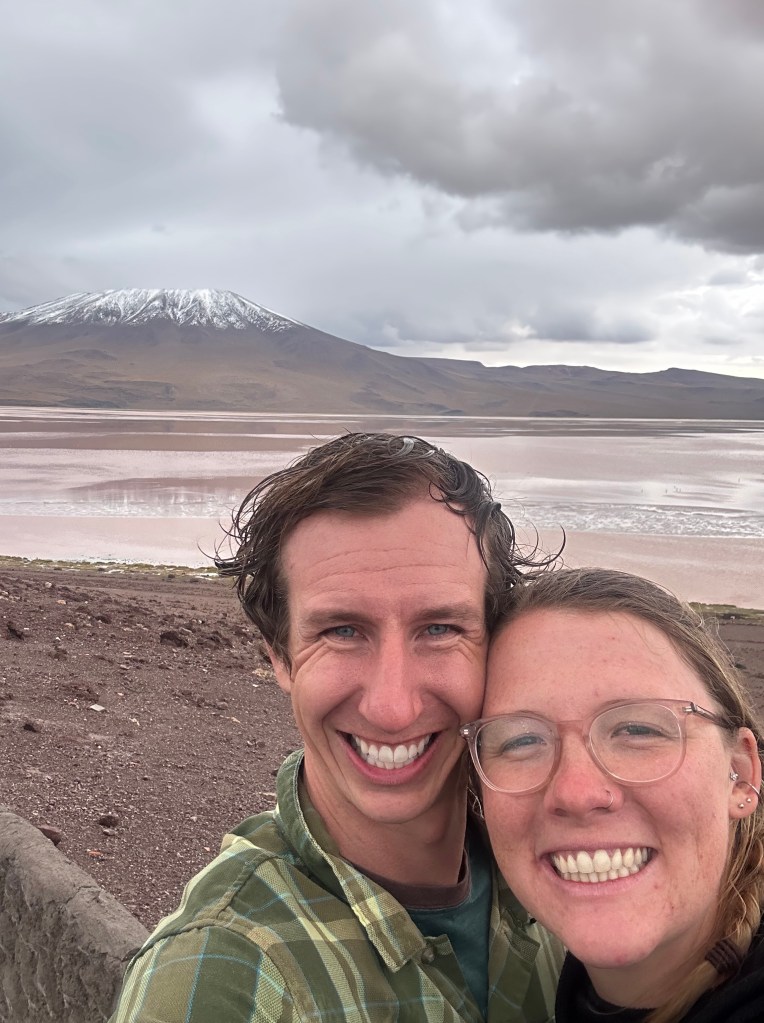
By midday, we reached what many consider the crown jewel of the Bolivian Altiplano – Laguna Colorada (Red Lagoon). As we crested a ridge, the lake came into view and blew us away.. The water was a deep rust red, created by algae that thrive in the mineral-rich water. But what made the scene truly spectacular were the thousands of Andean and Chilean flamingos that dotted the lake like pink exclamation points against the red backdrop.

Even though it started to rain on us, we spent over an hour at Laguna Colorada, watching the flamingos and marveling at both their sheer numbers and beauty.The shoreline was crusted with white borax deposits, once again creating that snow-like appearance that had fascinated us in Valle de Luna. The contrast between the white shore, red water, and pink birds against the blue sky was almost too perfect to be real.

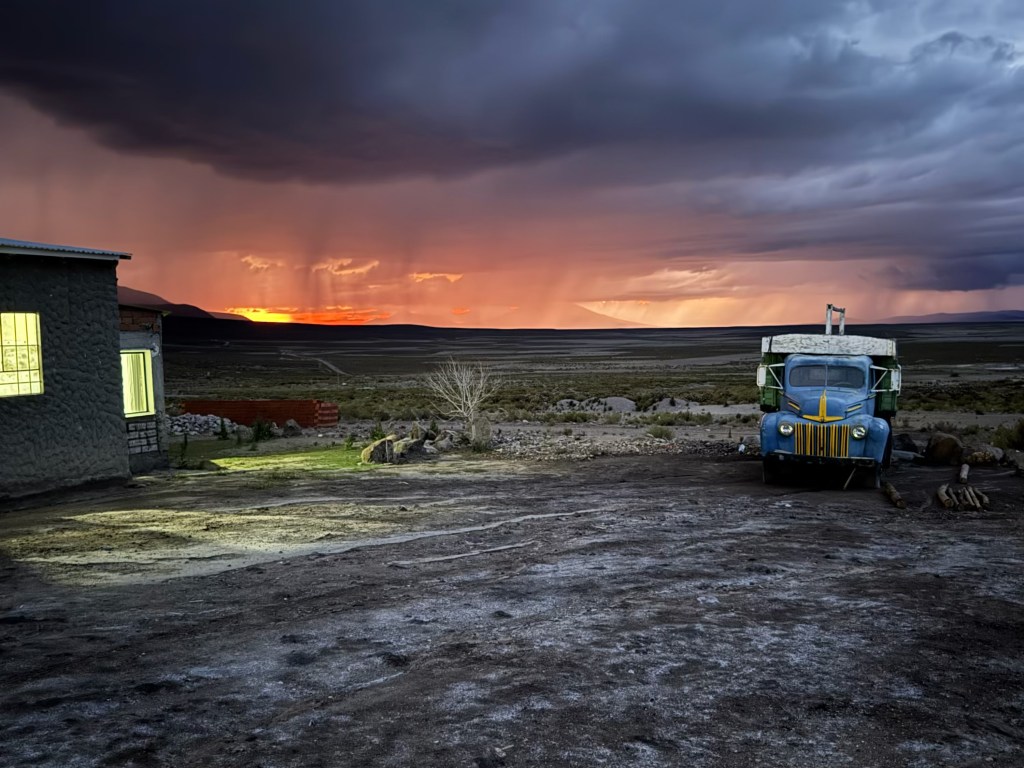
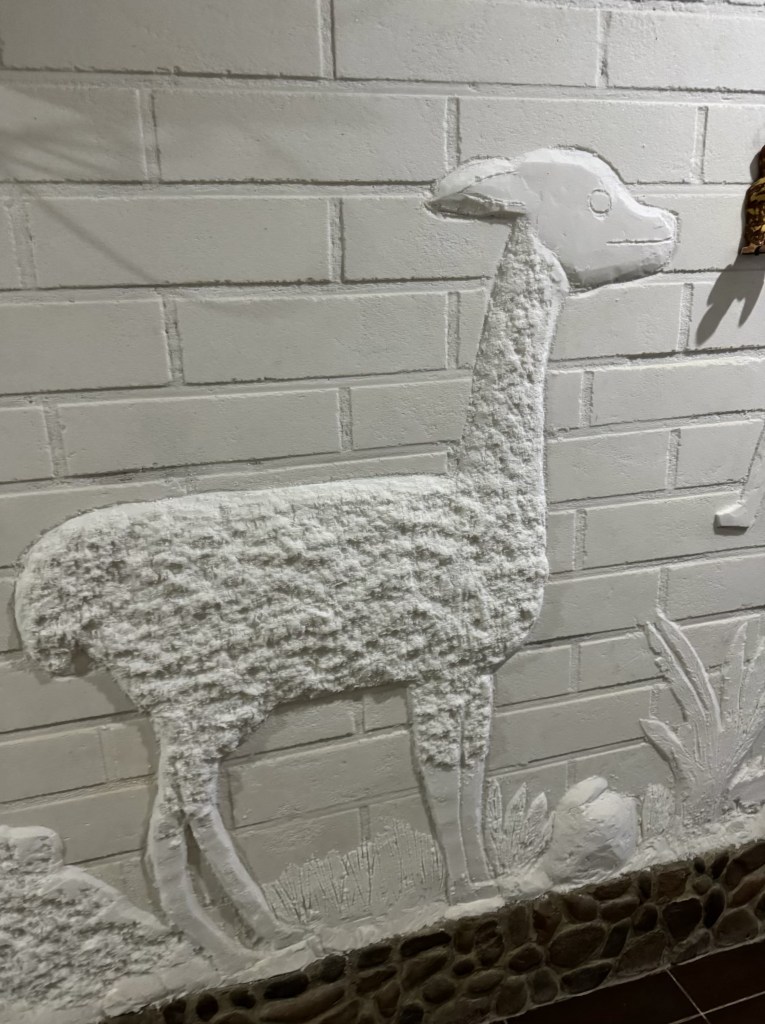
Our second night was spent in very unique hotel that was entirely made of salt! Everything from the walls to the bed platforms were made from salt blocks. Of course we had to lick a wall to confirm it was indeed all salt. That night we had a massive thunderstorm roll through which knocked out the power for the evening but we were happy to huddle in our salt bed.

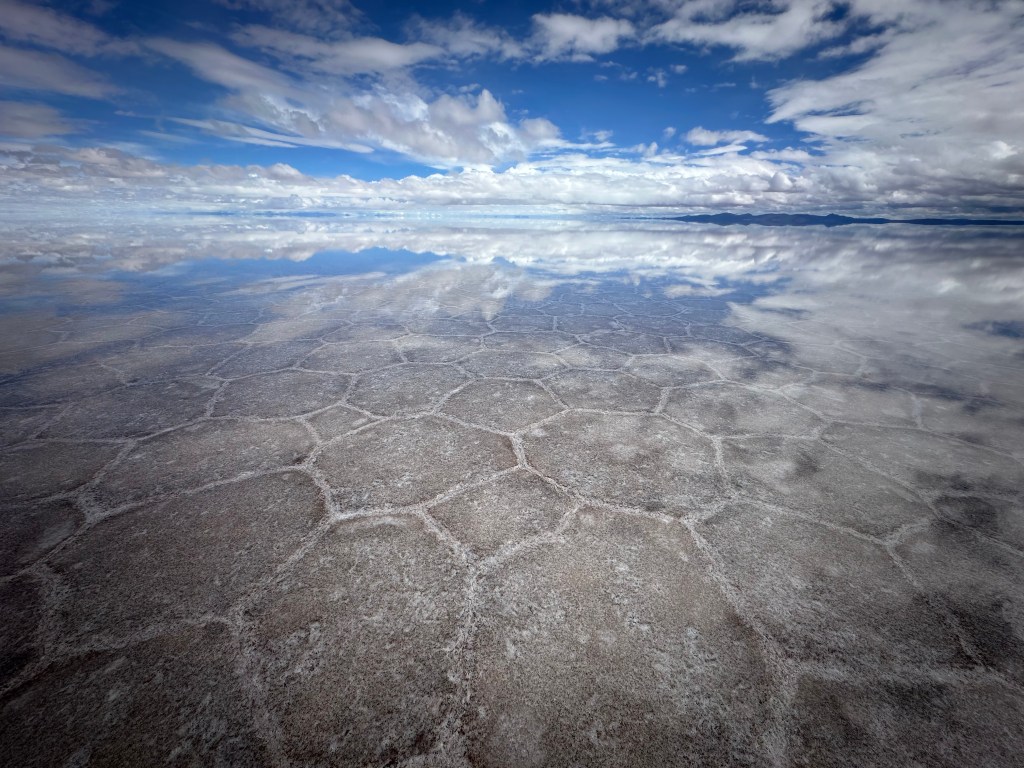
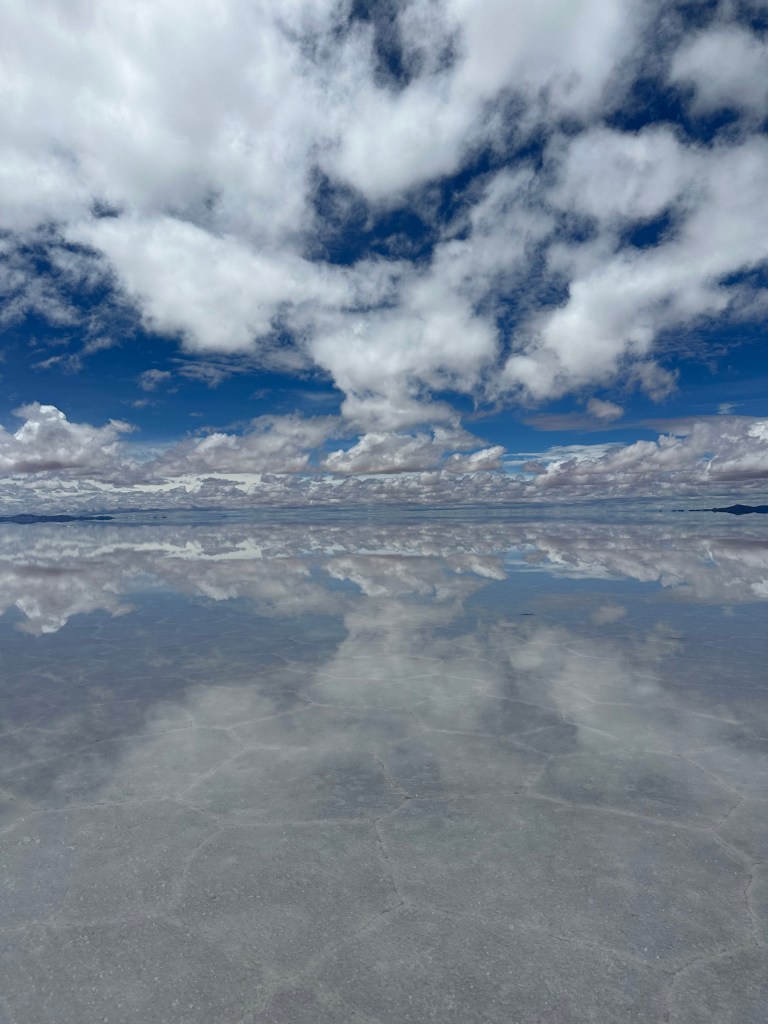
On the third day, we finally reached the edge of the main attraction – the vast Salar de Uyuni, the world’s largest salt flat. The timing of our visit couldn’t have been more perfect. We had arrived during what locals call the “mirror season,” when a thin layer of water covers parts of the salt crust, creating a perfect reflection of the sky above and the thunderstorm from the night before ensured the entire salt flat was covered in an inch of water.

As our Land Cruiser slowly drove onto the flooded salt flat, it felt like we were driving directly into the sky. The boundary between earth and heaven disappeared completely, creating the illusion that we were floating in an infinite blue expanse. Eduardo stopped the vehicle in the middle of this surreal mirror world, and we carefully stepped out into the otherworldly landscape.

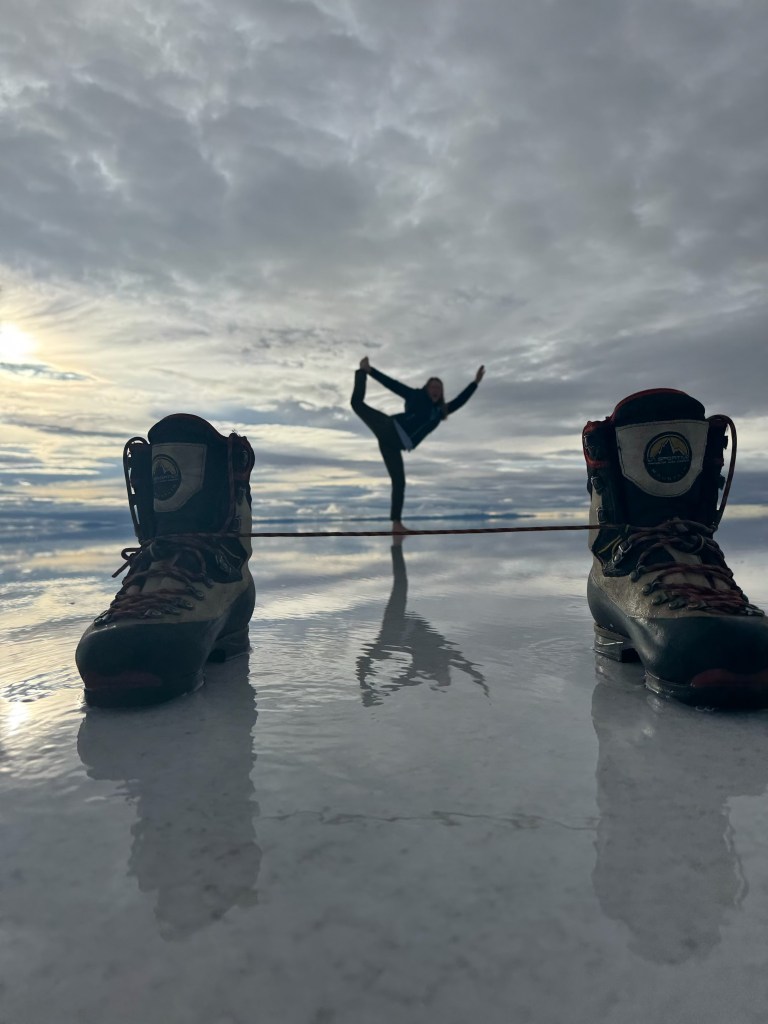
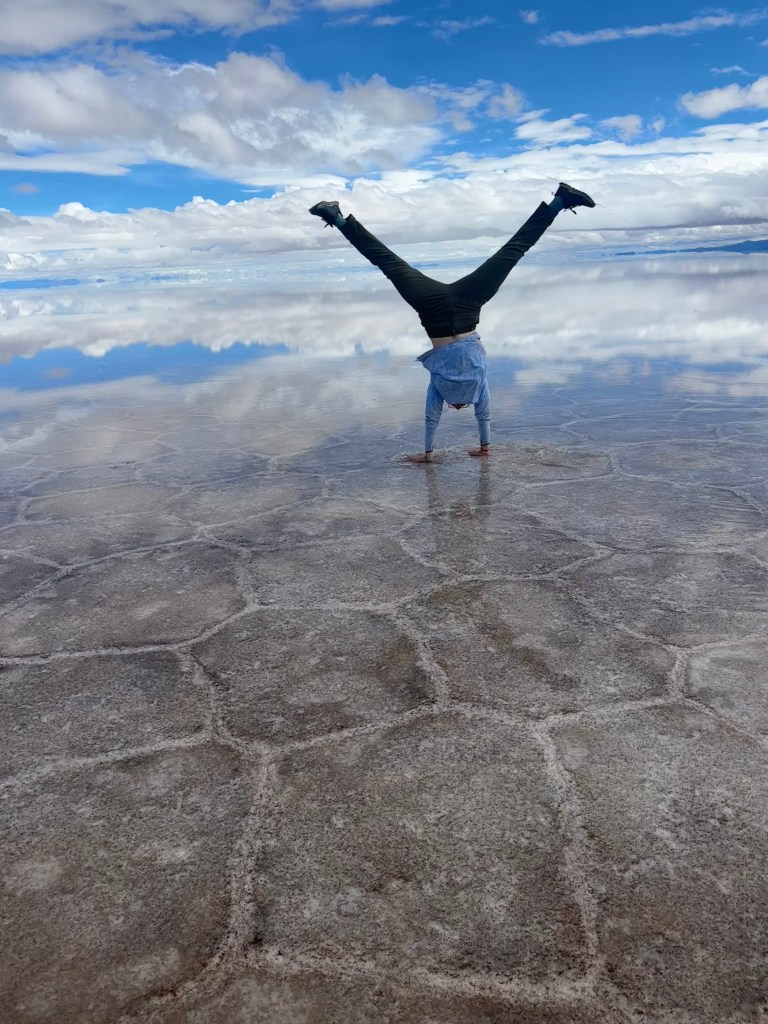
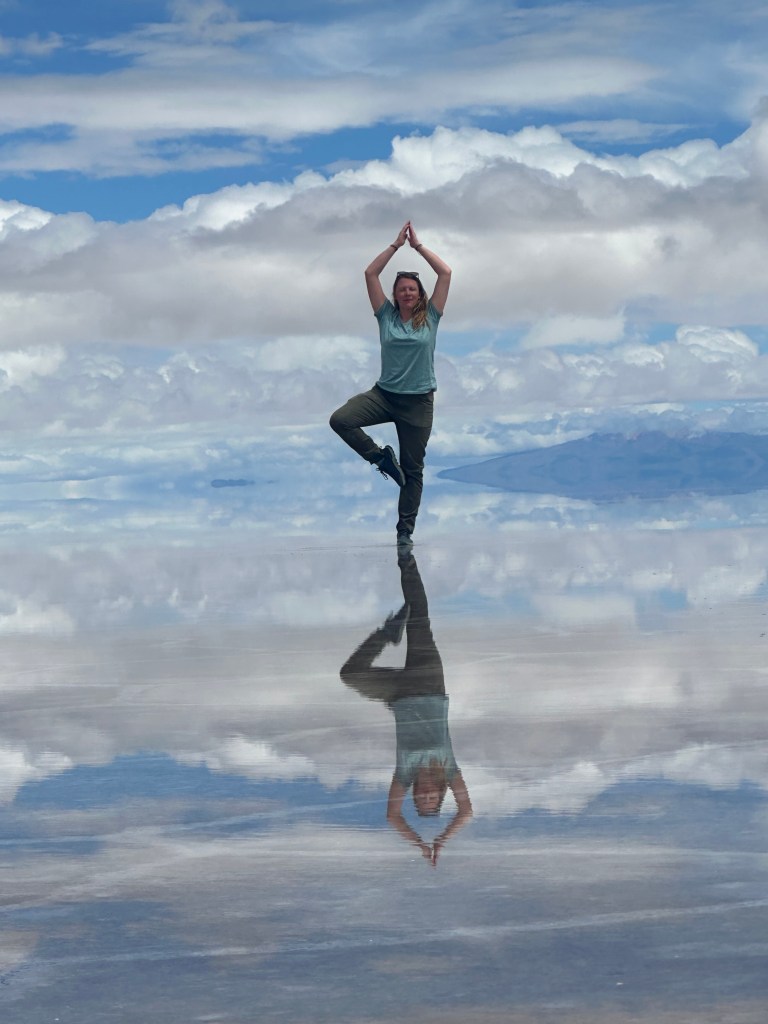
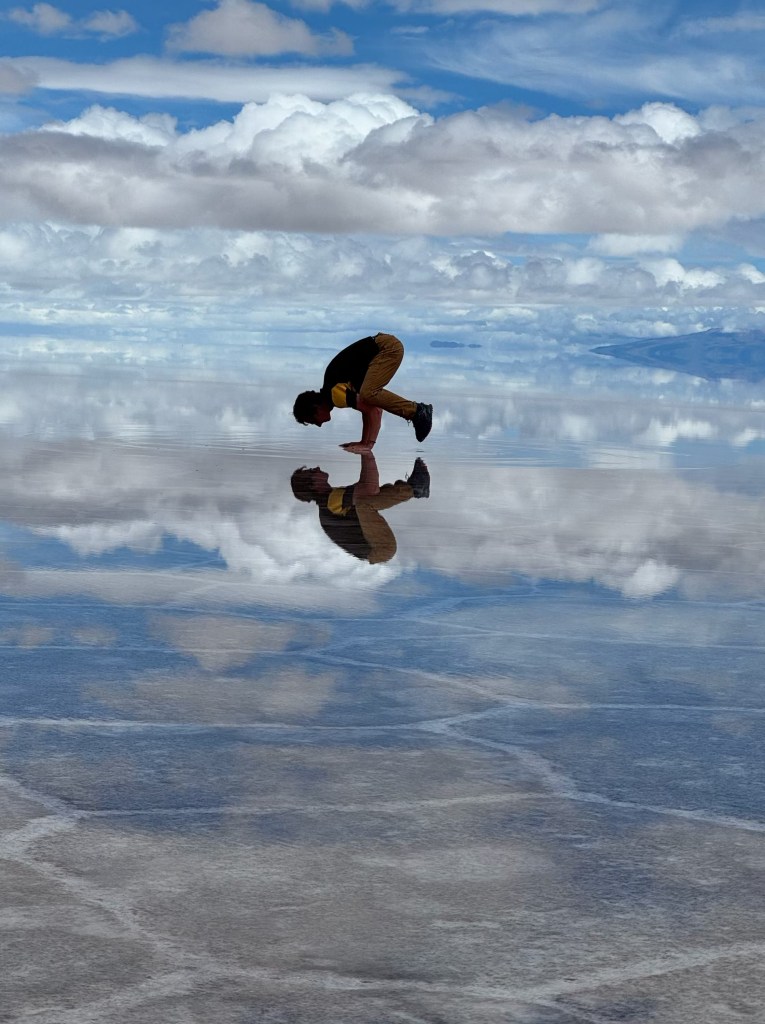
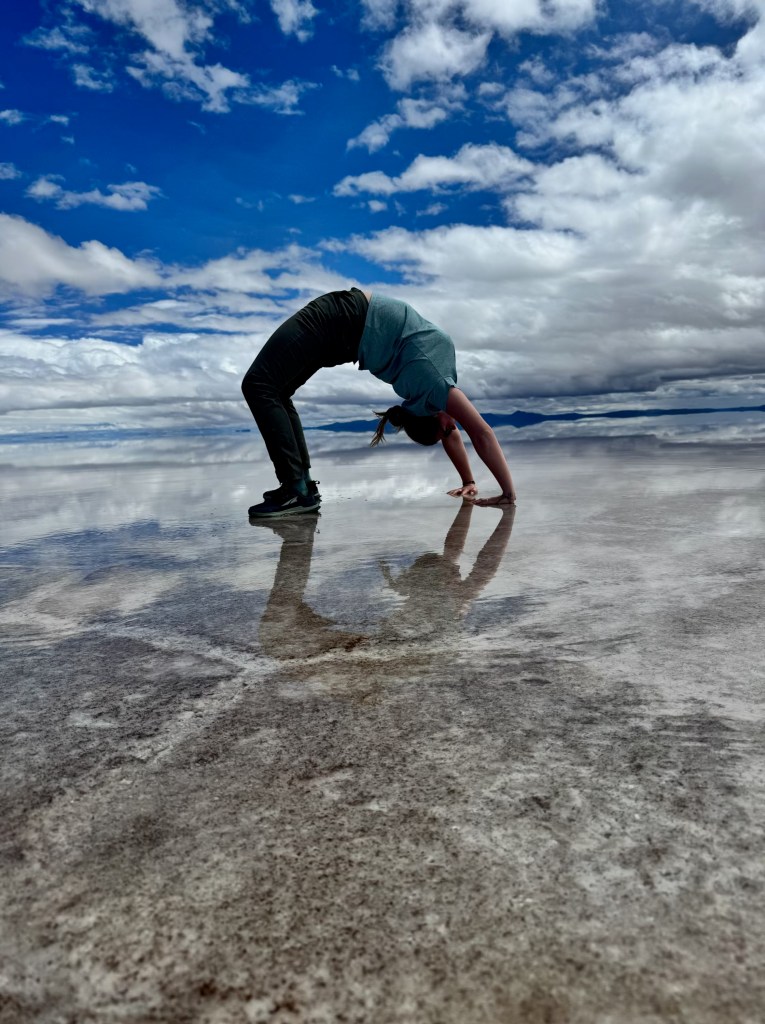
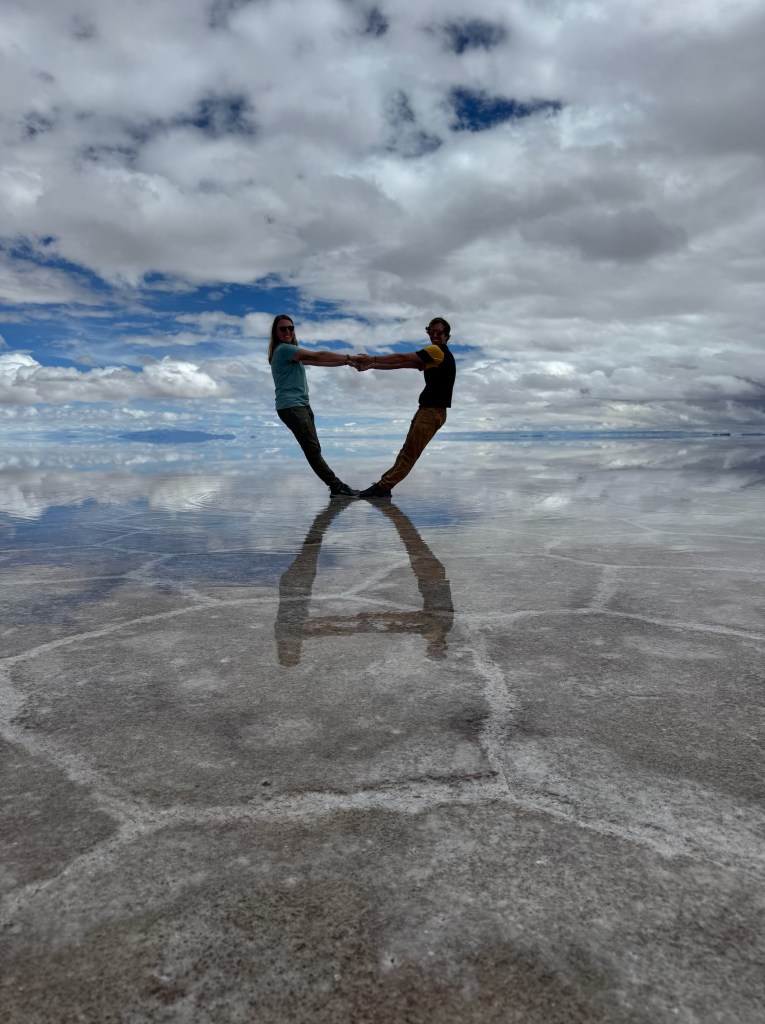
“Perfect for the photos,” Eduardo smiled, clearly familiar with what tourists want from this unique landscape. And he was right. We spent the next two hours taking some of the most incredible photos of our entire journey. The perfect reflection created mind-bending optical illusions – Nikki appearing to stand on her own reflection and both of us appearing to walk through the clouds. The perspective tricks that are possible here are endless, and we laughed like children as we staged increasingly absurd scenarios.

In all of our travels, we have never experienced a place like Salar de Uyuni. The mirror effect was such a unique experience and we highly recommend everyone visit if they have a chance.

On our final day, we made the long drive back toward the Bolivia-Chile border. The tour was amazing but also exhausting. Each day was 14+ hours but the views and landscapes we saw were absolutely worth it. It was fun to be part of tour for a little bit but there’s something profoundly comforting about returning to your own space after an adventure like this.

When we finally made it back to San Pedro and found Taka exactly as we had left her, we felt whole again. We thanked the host profusely for keeping watch over our home-on-wheels, and that night, as we lay in our own bed in Taka’s snug cabin, we scrolled through the hundreds of photos we had taken.

The mirror images of the Salar de Uyuni, the thousands of pink flamingos at Laguna Colorada, the surreal Salvador Dali landscapes, and the perfect volcanic cones reflected in Laguna Blanca. As sad as it was to leave Taka behind, this 4-day excursion into Bolivia had given us access to some of the most extraordinary landscapes we had ever seen.

Finally Made it to the Atacama!

In 2020 when we sadly had to cut our trip of a lifetime short, one of my biggest regrets was not seeing the Atacama desert. As we left the beautiful coastline of the Pan de Azucar and Ruta 1, I knew our next stop was the famous San Pedro de Atacama. We had heard countless tales about the otherworldly landscapes, and we were itching to experience the lunar valleys and salt flats for ourselves.

San Pedro de Atacama is a small desert oasis that has become a major destination for travelers exploring northern Chile. The town itself is charming in a rustic way – adobe buildings line narrow dirt streets, with small shops selling everything from alpaca wool sweaters to locally-made art. We felt that many of the reviews online of the town were too harsh – we enjoyed the little dirt roads and the little restaurants we found along them. Upon arriving we explored the city and got our bearings before heading back out to the desert to find a campsite. We found one of best campsites ever on the backside of Valle de Luna. It was the perfect remote, quiet desert campsite.

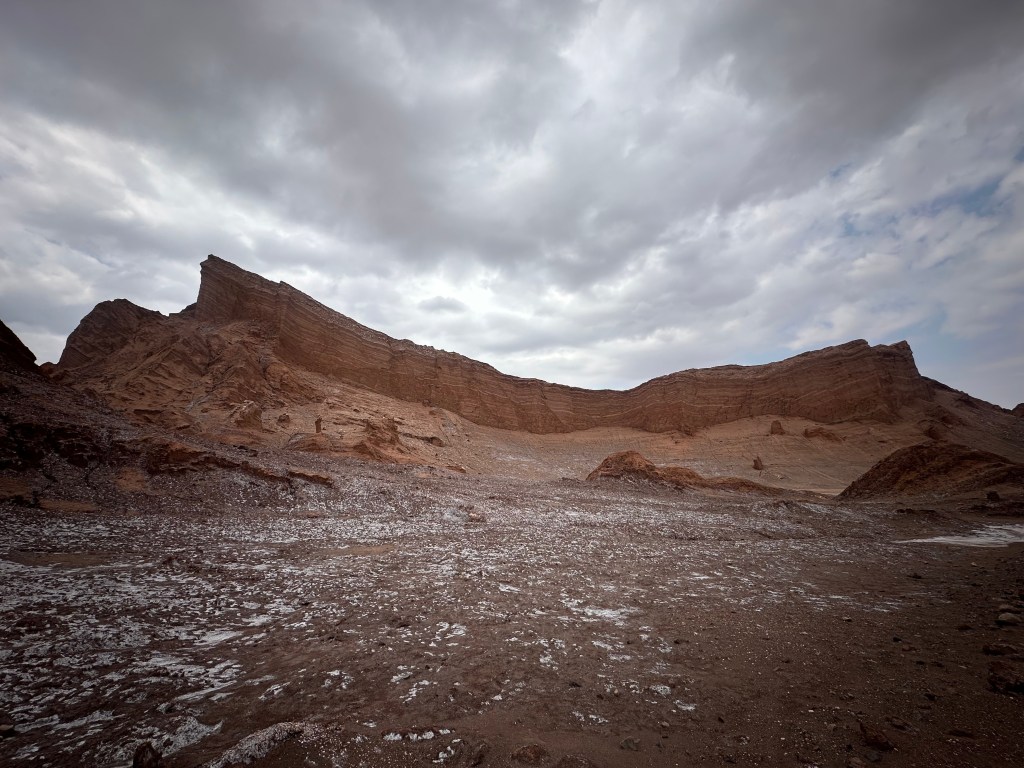
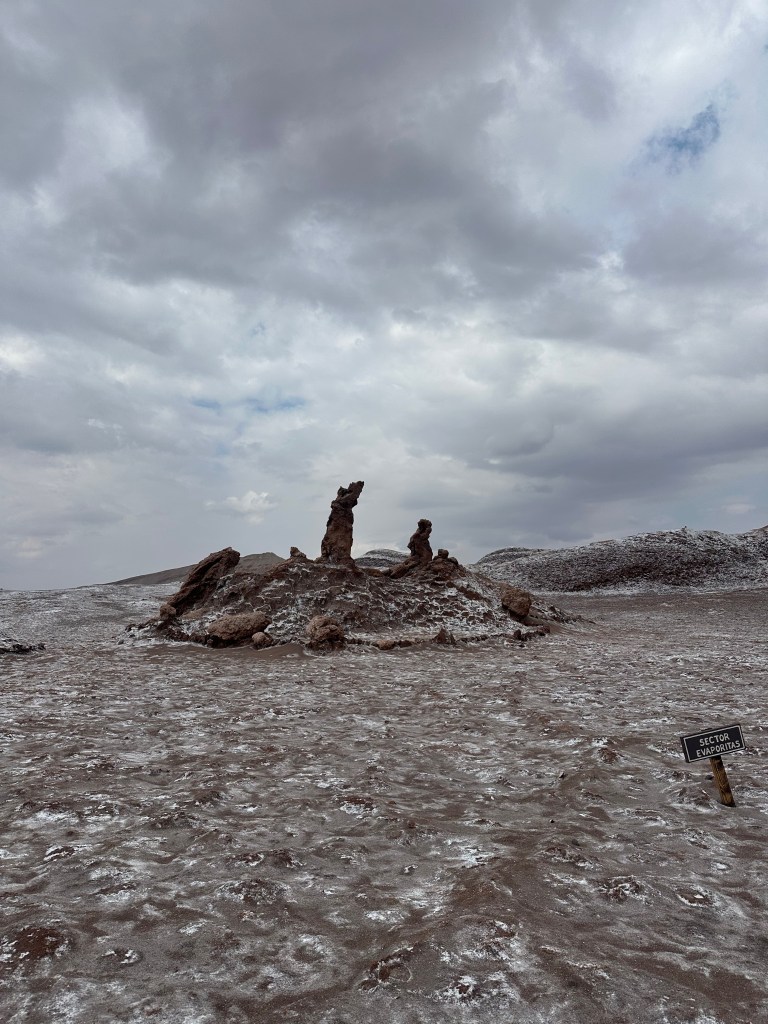
Our first adventure the next day was exploring the famous Valle de Luna (Moon Valley), just a short drive from town. A big benefit to overlanding is being able to take our own car to explore places, rather than joining a tour, which gave us the freedom to explore at our own pace. As we drove through the entrance gate, the landscape opened up to reveal something that truly looked extraterrestrial. Massive sand dunes flanked by jagged salt-crusted rock formations stretched as far as we could see. The earth around us was a palette of browns, whites, and oranges all crusted with salt.

What struck us most was how the salt deposits covering the ground and rocks created an illusion of freshly fallen snow. In some areas, the white coating was so thick and pristine that we had to remind ourselves we were in one of the driest deserts on Earth, not a winter wonderland. The contrast between the brilliant white salt and the rusty red earth beneath created a surreal landscape that seemed to belong to another world entirely. When the sunlight hit these salt-crusted areas, they sparkled like fields of diamonds against the harsh desert backdrop.

We parked Taka at one of the designated areas and hiked up to the ridge of a massive dune. The climb wasn’t long, but the views from the top were absolutely worth it. Below us, the salt crusted valley gave way to the distant Licancabur volcano which provided a perfect backdrop. We stayed until sunset, watching as the entire valley transformed in the golden light, the shadows stretching across the salt plains and the rocks taking on an almost fiery glow. It was easy to understand why NASA has used this place to test Mars rovers – it really does feel like another planet.

The next day, we decided to seek some relief from the desert heat by visiting Laguna Cejar, a salt lake about 30 minutes from San Pedro. We had been told that the water was so saline-dense that floating was effortless – something we had to experience for ourselves. The road to the lagoon was rough, and I was grateful for Taka’s sturdy suspension as we bounced along the washboard dirt tracks.

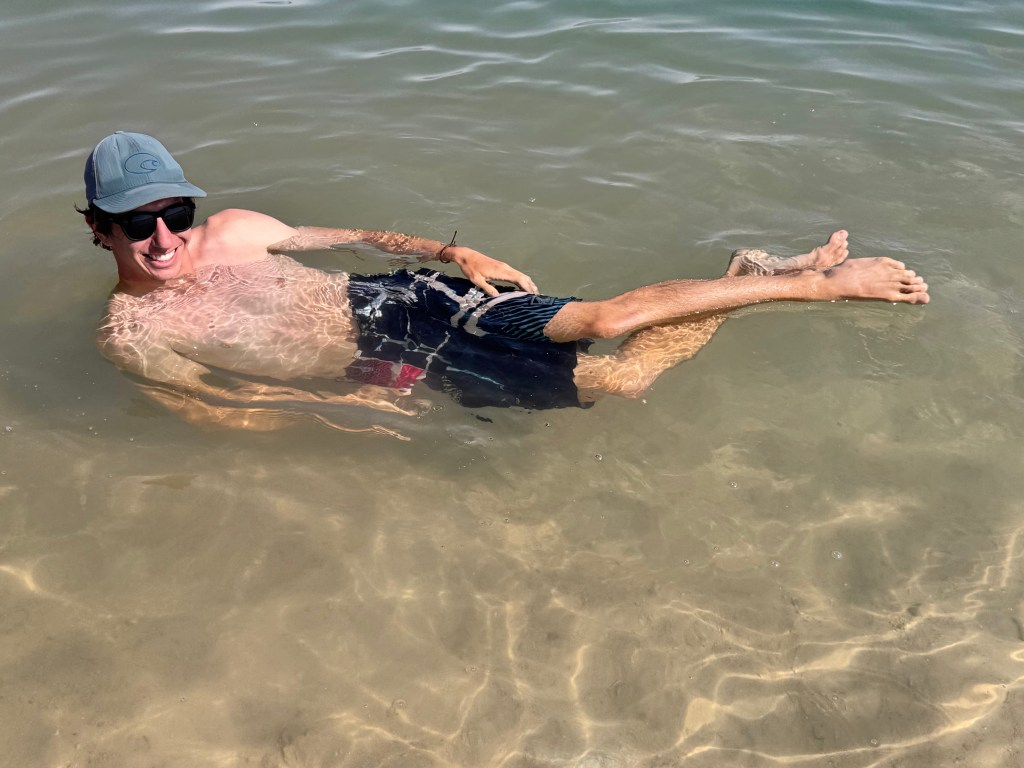
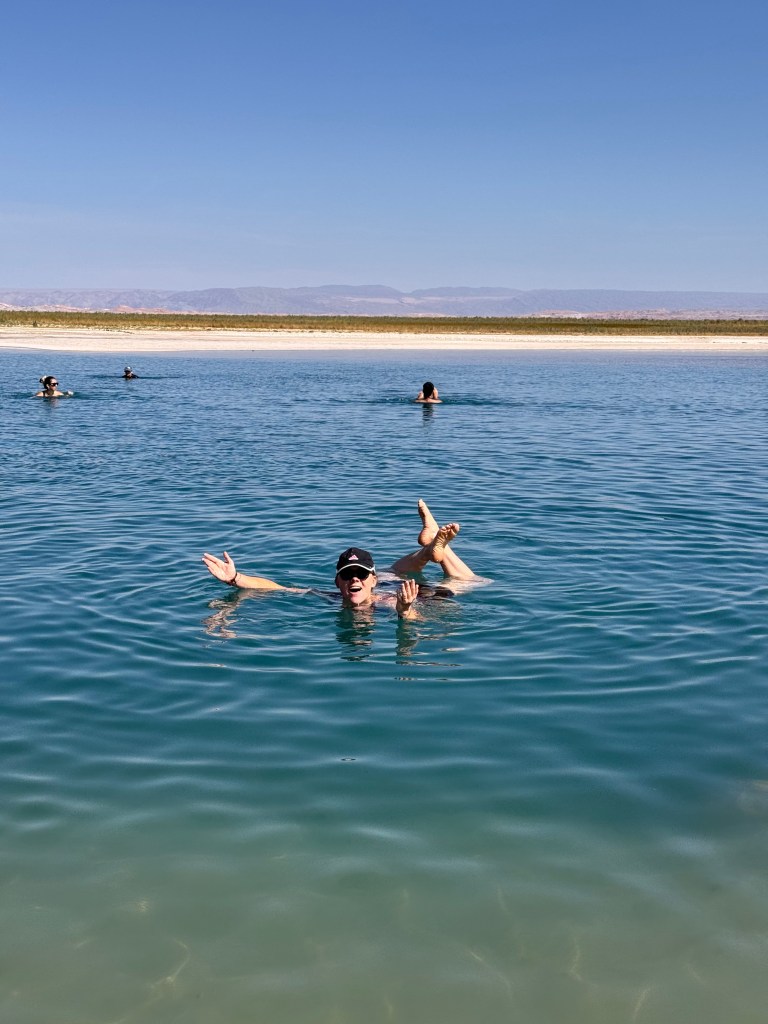
When we arrived, the lagoon appeared like a mirage – a pool of impossibly blue water surrounded by white salt crusts and distant volcanoes. It was crazy to see a reasonably sized lagoon in the middle of the desert. We changed into our swimsuits and cautiously approached the edge of the lake. Before even reaching the edge of the water, we could taste a faint but noticeable salty flavor in the air. But the real shock came when I eased myself in and immediately bobbed to the surface like a cork! Nikki laughed as she joined me, and soon we were both floating effortlessly, our bodies suspended in the dense, mineral-rich water.

“This is crazy!” Nikki exclaimed as she tried, unsuccessfully, to touch the bottom while floating.  Here whole body was vertical like a pencil but still she floated effortlessly. The experience was surreal – we lounged in the water, staring up at the perfectly blue sky while being completely supported by the saline solution. The only downside was the warning we had received about not getting the water in our eyes or any cuts – the salt concentration did sting any minor cut terribly. After about half an hour of floating, we reluctantly got out, immediately feeling the salt crystalizing on our skin as the water evaporated in the dry desert air. The nearby shower facilities were great, allowing us to rinse off before the salt completely encrusted us.

Our final day in San Pedro was spent tackling some much-needed maintenance on Taka. The rough desert roads and extreme temperature fluctuations had taken their toll, and our trusty truck needed some attention. We found a small mechanic shop where the owner was more than happy to help us change the oil and fix some small alignment issues. He seemed genuinely interested in our truck camper setup and our journey through South America. 

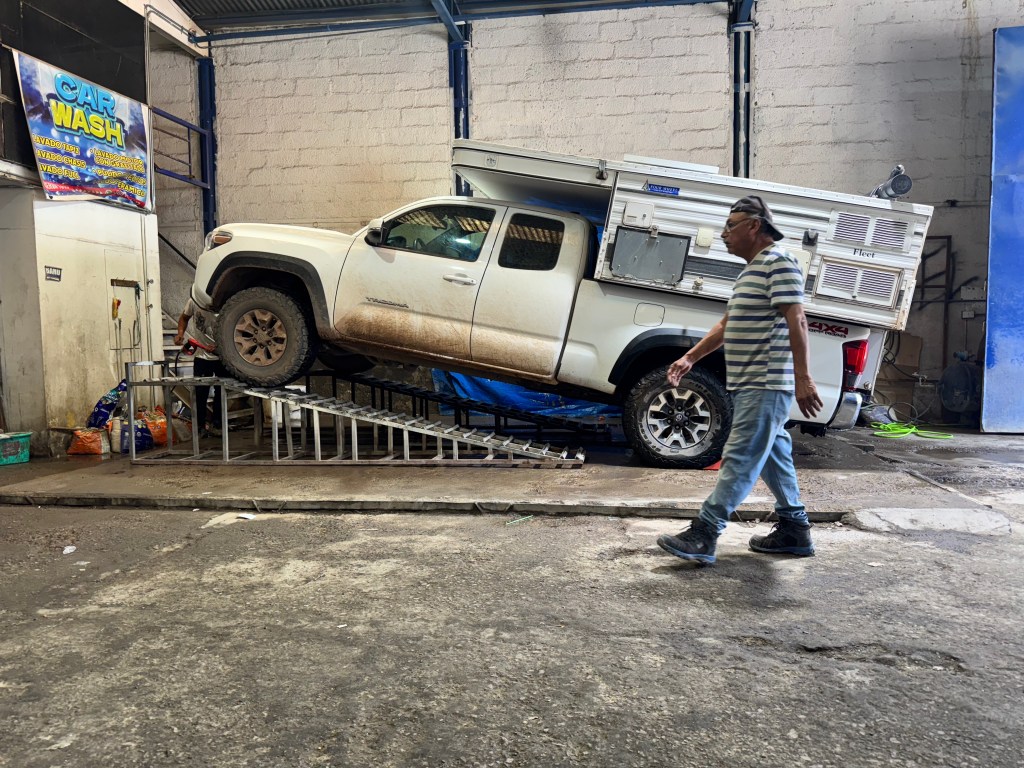
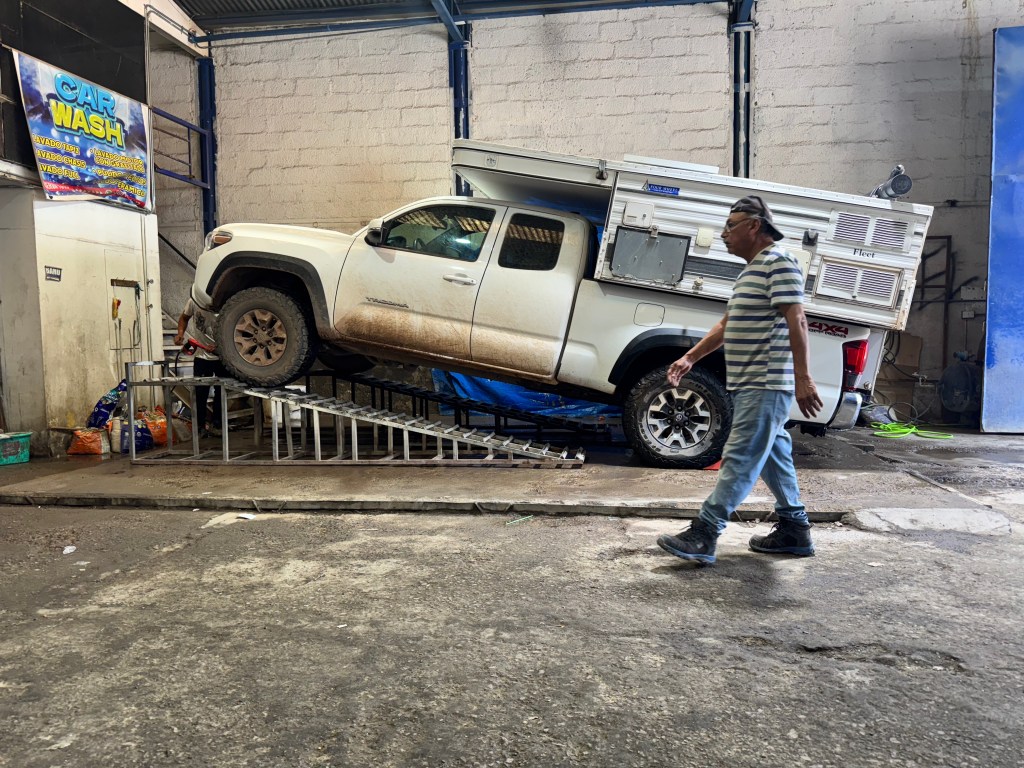
The biggest issue, however, was the salt. Taka was covered in a thick layer of salt dust that had accumulated from our excursions around the salt flats and Valle de Luna. “This will eat through your undercarriage if you don’t get it off,” the mechanic warned us in Spanish. He directed us to a car wash on the edge of town that specialized in cleaning vehicles that had been out on the salt flats. We spent almost two hours at the car wash, where they meticulously pressure-washed every nook and cranny of Taka’s underside, wheel wells, and engine compartment. The amount of salt that washed away was astonishing – creating small white rivers that flowed across the concrete pad.

As we prepared to leave San Pedro de Atacama the next morning, we found ourselves feeling a bit melancholy. There was still so much to see in the area – the El Tatio geysers, the high-altitude lagoons with their pink flamingos, the ancient petroglyphs scattered throughout the canyons. But we had scheduled a tour to cross into Bolivia to explore the Salar de Uyuni.

Our departure, however, didn’t go quite as planned. The night before we were set to leave, we decided to risk eating some leftover pesto and gnocchi that might not have been sufficiently refrigerated. By midnight, both Nikki and I were violently ill with food poisoning. 

We spent a miserable night taking turns rushing out of Taka into the cool desert air. The temperature in the Atacama drops dramatically at night but luckily it wasn’t the coldest night of our trip… Either way there we were, sick as dogs, shivering in the moonlight. At one point, I remember looking up at the star-filled sky between bouts of nausea and thinking that even in our misery, the beauty of this place was undeniable. I really could not think of a better view while having food poisoning. By morning, we were exhausted and dehydrated but thankfully the worst had passed and we felt well enough to join our tour to Bolivia.

It wasn’t exactly how we had planned to end our time in San Pedro, but it certainly gave us a story to tell. Throughout the journey, we’ve learned that not every experience on the road is Instagram-worthy (and we are notoriously bad at posting online, although Nikki has made a resolution to do better in sharing our journey), but even the challenging moments become part of the adventure. Still feeling a bit queazy, we pulled into a parking lot/overlander campsite that was going to watch Taka while we were on the Bolivian tour. Immediately as we parked, we were met with a familiar face. One of the Swiss couples that had shipped to Montevideo on the same day as us was in the campsite! It was great to reunite with them and share stories of our travels. We grabbed dinner and a drink with them, comparing schedules and swapping stories. We decided to meet again in Cusco, Peru when we both planned to be there.  

We then joined our tour group and started the drive to the Bolivian border. The Atacama Desert had delivered on its promise of otherworldly beauty, and Taka had once again proven to be the perfect companion for exploring such remote and challenging terrain – even if we sometimes make ourselves sick with our own cooking.

Valle de ElquĂ­, Nevado de Tres Cruces and Pan de AzĂşcar

After our time in Mendoza, our journey continued into the mystical Valle de ElquĂ­. Known both for its crystal-clear night skies (home to several major international observatories) and as the birthplace of Chile’s beloved pisco.

We drove along winding roads that followed the Elquí River, watching as the landscape gradually transformed around us. The valley floor was a patchwork of vibrant green vineyards, stark against the arid brown mountains that rose steeply on either side. This contrast is what makes Elquí so special – the river brings life to the valley, creating this lush oasis in what is otherwise the edge of the Atacama, one of the driest places on earth.

Our first stop was in the small town of Vicuñas which reminded us of Santa Fe due to its fun art scene in the desert. We found a perfect campsite just outside of the city where we could enjoy the dark sky designation of the area. The night skies did not disappoint – we have never seen stars so bright or so numerous.

The following morning, we headed to one of the region’s local distilleries, Pisquera AbA. The tour began in the vineyards, where our guide explained how the unique microclimate of the valley – hot, dry days and cool nights – is perfect for growing the Muscat grapes used in pisco production. Unlike wine grapes, pisco varieties are selected for their aromatic qualities rather than their flavor profile, as the distillation process concentrates these aromatics.

The tour led us through the full distillation process where the grapes are turned into a wine like drink and then transitioned to more of a brandy or moonshine distillation process. The huge copper pots that captured and refined the alcohol vapors were amazing to see.

The tasting that followed was eye-opening. We learned to sip pisco properly, noting how different it was from other grape brandies we’d tried. We really didn’t know much about different types of piscos and how the aging affected the taste. The younger piscos were vibrant and floral, while the aged reserves had a complexity that reminded me of fine whiskey, with notes of vanilla, caramel, and dried fruits. By the end of the tasting, we’d gained a new appreciation for Chile’s national spirit. While we enjoyed tasting the piscos, we still think the best way to drink pisco is in a pisco sour. Luckily for us, they had a wide variety of bottled pisco sours for purchase. We bought a grapefruit pisco sour bottle and planned to save it for a sunny beach day!

That evening, as we sat outside our camper and reminisced of our time enjoying some of the best wines and piscos in the world between Mendoza and ElquĂ­. While we had thoroughly enjoyed our relaxing days, we were ready to get back to the natural beauty of the Chilean mountains and to get back to hiking! One interesting park that piqued our interest was the remote and rarely visited Nevado de Tres Cruces National Park.

The journey to Tres Cruces was an adventure in itself. We left the ElquĂ­ Valley behind and headed eastward, climbing steadily into the high Andes. Taka tackled increasingly rough roads as we ascended, the air growing noticeably thinner with each switchback. The landscape transformed dramatically from the vineyards and river valleys, to rugged mountains with sparse hearty Andean vegetation. Nevado Tres Cruces is so remote that we had to do some calculations to see how much extra gas we needed. Due to the high elevation we had greatly reduced gas efficiency and therefore had to bring an extra 40 liters of gas with us.

We reached the park entrance at around 14,000 feet, where a friendly but surprised ranger checked our permits. He mentioned not many groups make it out this park other than people who want to climb Ojos del Salado, the highest volcano in the world at 22,615’. He and warned us about the altitude, recommending we move slowly and drink plenty of water. We knew the drill from previous high-altitude adventures but were grateful for his concern.

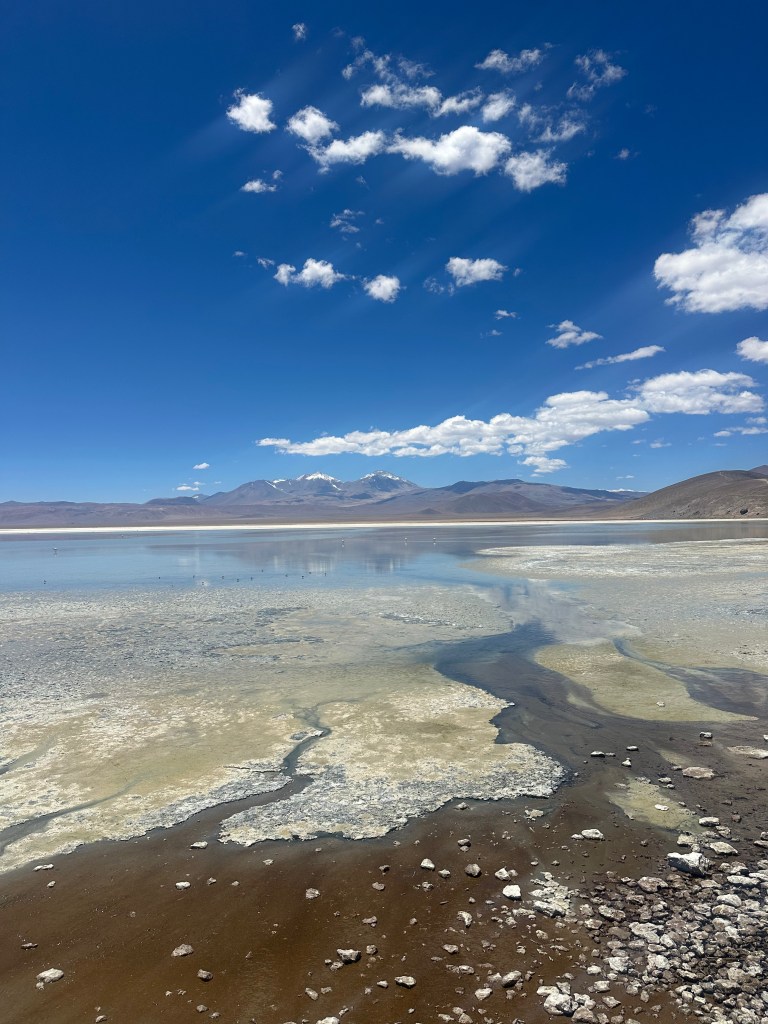
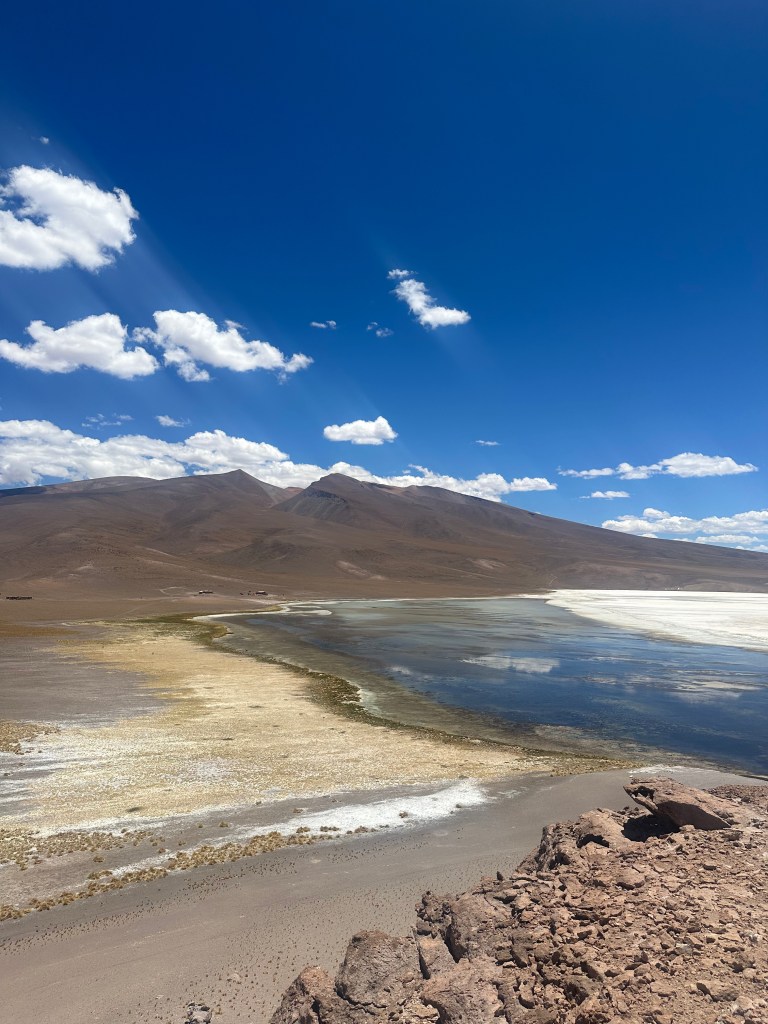
The centerpiece of Nevado de Tres Cruces is the stunning Laguna Verde, a saline lake shimmering with an almost unreal emerald color due to its mineral content. As we carefully drove the rough track around the lake, we were treated to one of the highlights of the Andean altiplano (high plains) – dozens of flamingos feeding in the shallows, their pink plumage vivid against the green water and blue sky.

The park ranger joined us while we watched the beautiful scene before us. He mentioned that they have both the Chilean and Andean flamingos here in the park. We spent more than an hour simply watching them feed on the algae and microscopic shrimp. The silence was absolute except for the occasional squawk of the birds and the constant high-altitude wind.

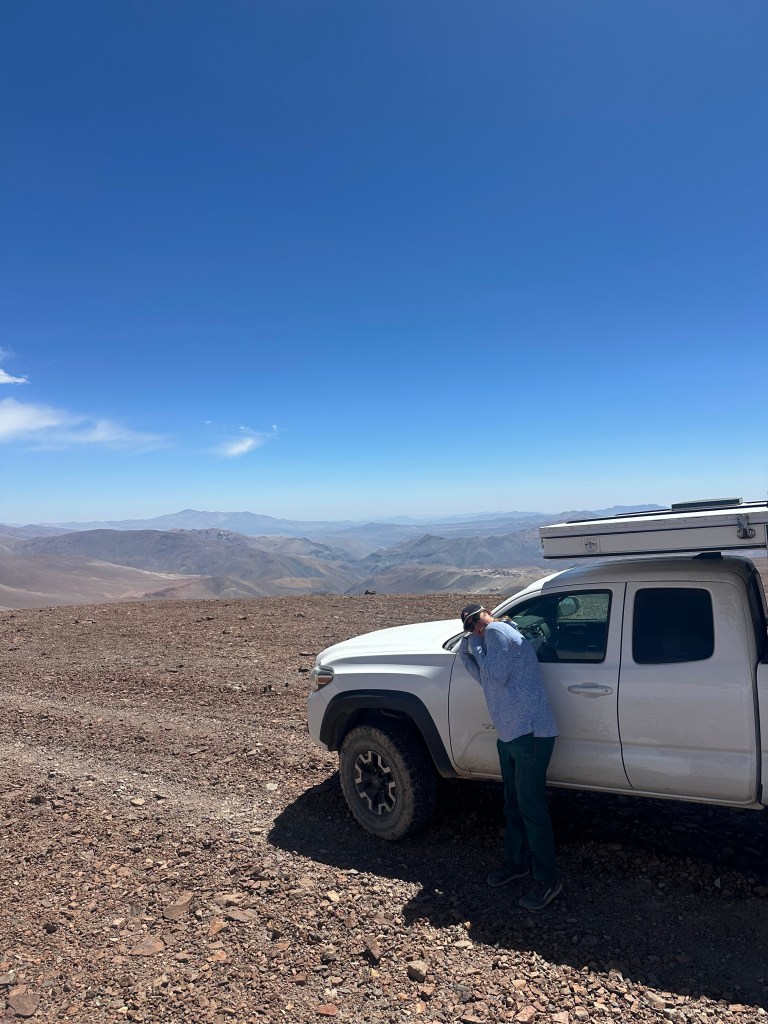
The following day brought our most ambitious drive yet – a slow crawl up the mountain road to over 16,000 feet, one of the highest points we’d ever taken our vehicle. Tony (the truck part of Taka) performed admirably despite the thin air, and we finally reached a viewpoint overlooking not only Laguna Verde but also Laguna Santa Rosa in the distance and an amazing view down the valley we had driven up.

The view from that height was humbling. We could see into both Chile and Argentina, with massive volcanoes and peaks on the horizon. Despite the bitter cold and the challenge of breathing at that altitude, we lingered, mesmerized by the beauty surrounding us. Here Nikki is hugging Tony and thanking him for the trusty ride up the mountain side.

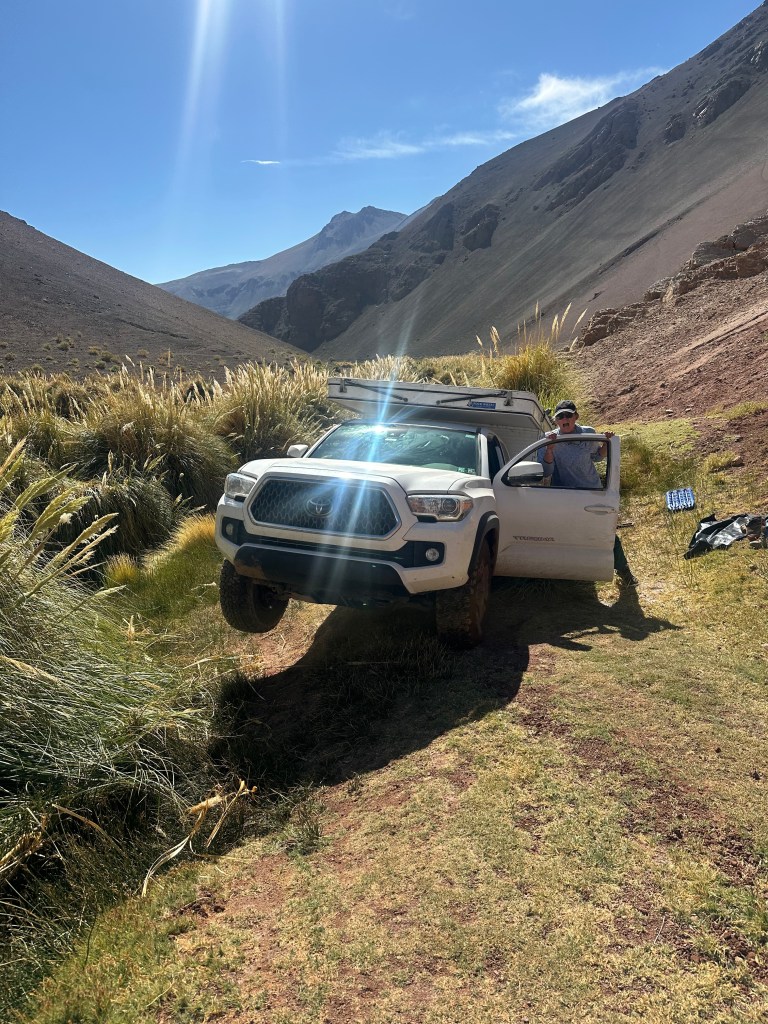
That night we slept at an amazingly remote wild campsite but even that had its own challenges. When we turned off the main road and were 5 minutes from the campsite, we had to shift into 4wd to make it up a steep hill. Unknown to us, at the top of the hill a natural spring had created a 2-3 foot mud pit on the left side of the road. Right as we were about to crest the hill, both of our left tires sunk into a farm pigs heaven – full of slop and mud. The immediate drop made our hearts sink and our front right tire fly into the air. We both knew, we were in a bit of trouble. Getting out of the car we were greeted with a humbling, but in retrospect, pretty cool scene. With both left tires stuck in the mud and only one right tire touching the ground, we knew we had some work to do. We spent the next hour digging out all the mud that we could so we could insert our traction boards under the tires. We then used Taka’s auto climbing mode for the first time on the entire journey to try and escape the bog. What happened next is entirely credited to Nikki’s driving and the off-roading capability of the Tacoma TRD Off-road. The automatic climbing mode took over and sensed which wheels could gain traction. It then sent power to those wheels only. Once Taka started to move, the left wheels hit the traction boards and Take immediately sent power to those wheels. Once the left wheels had traction and power, Taka leapt forward. Nikki expertly steered Taka up and out of the mud pit while narrowly avoiding tipping over due to the unevenness of the road. We were so happy to have gotten through our first time ever getting fully stuck. We deserved our beer that night.

After two days in this otherworldly landscape, we reluctantly began our descent, planning to make our way toward Pan de AzĂşcar National Park on the Pacific coast. The transition from the extreme heights of the Andes to the sea level of the Pacific was dramatic, and the change in ecosystems equally so.

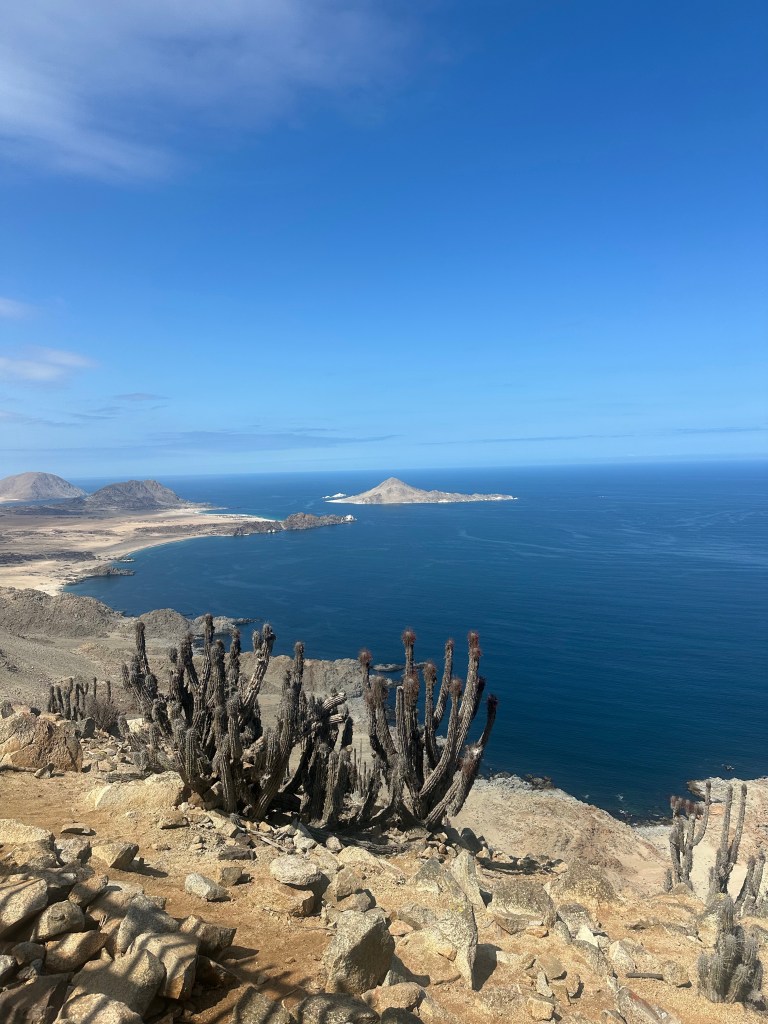
Pan de AzĂşcar marks the point where the Atacama Desert meets the Pacific Ocean, creating a landscape unlike any other. The park is named for the distinctive sugar loaf-shaped island visible from the shore, and our first hike there greeted us with perfect views of this landmark, surrounded by the deep blue of the Pacific. We spent that day hiking the Mirador Trail, which winds along coastal cliffs offering spectacular vistas of the rugged shoreline. The contrast between the parched desert landscape on one side and the endless ocean on the other was striking – two of earth’s most extreme environments meeting in one dramatic coastline.

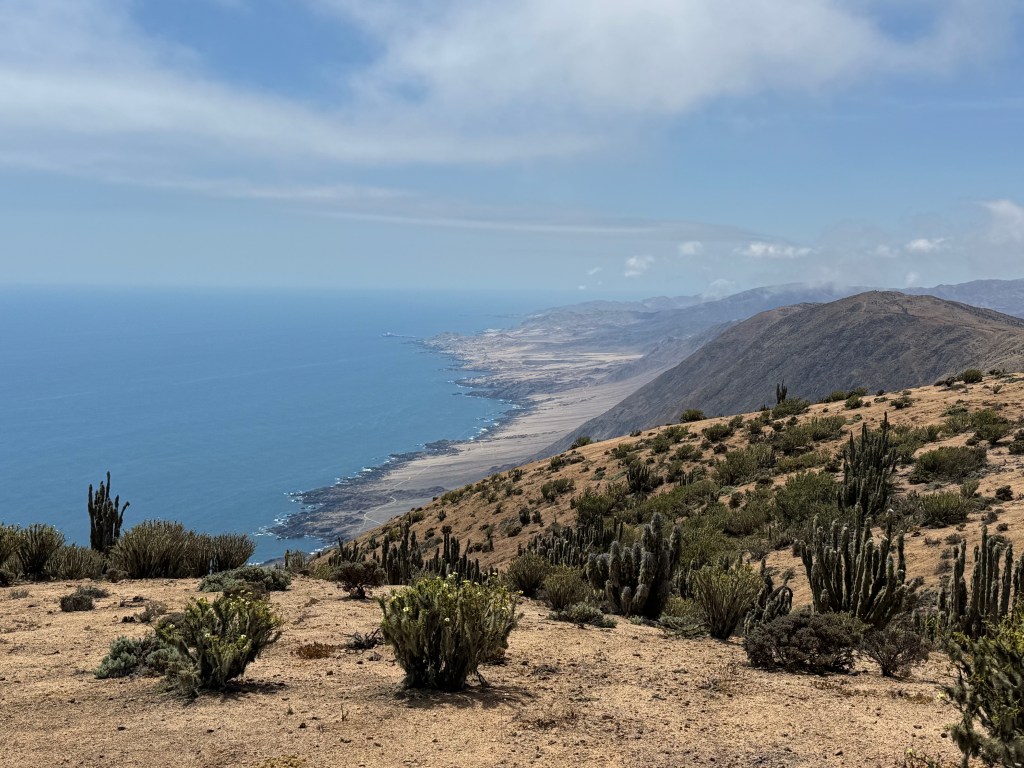
What makes Pan de AzĂşcar truly special is the coastal fog, or camanchaca, that rolls in from the ocean. This life-giving mist supports an extraordinary variety of plant life in what would otherwise be barren desert. On our second day, we did a longer hike that wound its way though barren cactus landscapes to arrive on top of a 1,000 ft cliff overlooking the ocean. At this overlook there were numerous huge nets that captured and collected the ocean fog. There was even a small sink where you could taste the clear and clean water. This was our favorite hike in the park because despite receiving almost no rainfall, the cacti and other desert plants were surviving and blooming due to the moisture from the coastal fog alone.

It was great to be back getting our feet underneath of us and accumulating miles. We wanted to keep our hiking going in order to get back in shape for the high elevation backpacking we knew was coming once we passed into Peru. Our next stop in Chile is the famed San Pedro de Atacama where it feels like you leave Earth for a walk on the moon.

A Belated but Still Meaningful Honeymoon in Mendoza

After nearly 4 months on the road through South America, living out of Taka, navigating the ups and downs of long-term travel, we decided to splurge for our (belated, but still officially uncelebrated) honeymoon. Our destination of choice? The wine country of Mendoza, Argentina. We had heard tales of this region’s spectacular Malbecs and mountain views from fellow travelers for months, and it seemed like the perfect place to celebrate our marriage (from nearly 6 years ago lol). 

We arrived in Mendoza after a spectacular drive through the dramatic Andes mountains. The border crossing was something special because we remembered it as the first time COVID impacted our first trip. In 2020 when we crossed the boarder, Argentina was not admitting people coming from the United States due to rising COVID cases in the States. Upon seeing our US passports, we got very troubled looks as they debated whether to admit us. I had to explain to the boarder agent that we had been in South America for 6 months, which thankfully he fully understood and admitted us into the country. This time around, the crossing was much smoother and soon enough we found ourselves Mendoza bound for the 2nd time.

Unlike our usual nights camping in the back of our truck, we had splurged on a cute stone house Airbnb in MaipĂş, about 15 kilometers from downtown Mendoza. When we pulled our dusty Tacoma up to the property, I could tell immediately we had made the right choice. The little house was tucked behind a larger main residence, surrounded by flowering vines and with its own private garden. Made of local stone with wooden beams across the ceiling, it felt both rustic and luxurious compared to our camper setup. The small kitchen meant we could still cook some of our meals (keeping the overlander budget somewhat intact), which we made full use of.

After settling in and showering away the road dust, we decided our first full day would be dedicated to exploring the wineries closest to our stone house. Mendoza’s wine regions are divided into several areas – MaipĂş, Luján de Cuyo, and the Uco Valley being the most famous. MaipĂş might not be as prestigious as the others, but it had the distinct advantage of being a short drive from our Airbnb, meaning we could visit several bodegas while having a designated driver. 

The first stop was Bodega Azul, a family-run operation we’d heard had excellent small-production wines that rarely made it out of Argentina. The bodega was housed in a beautiful old building with striking blue accents (hence the name). 

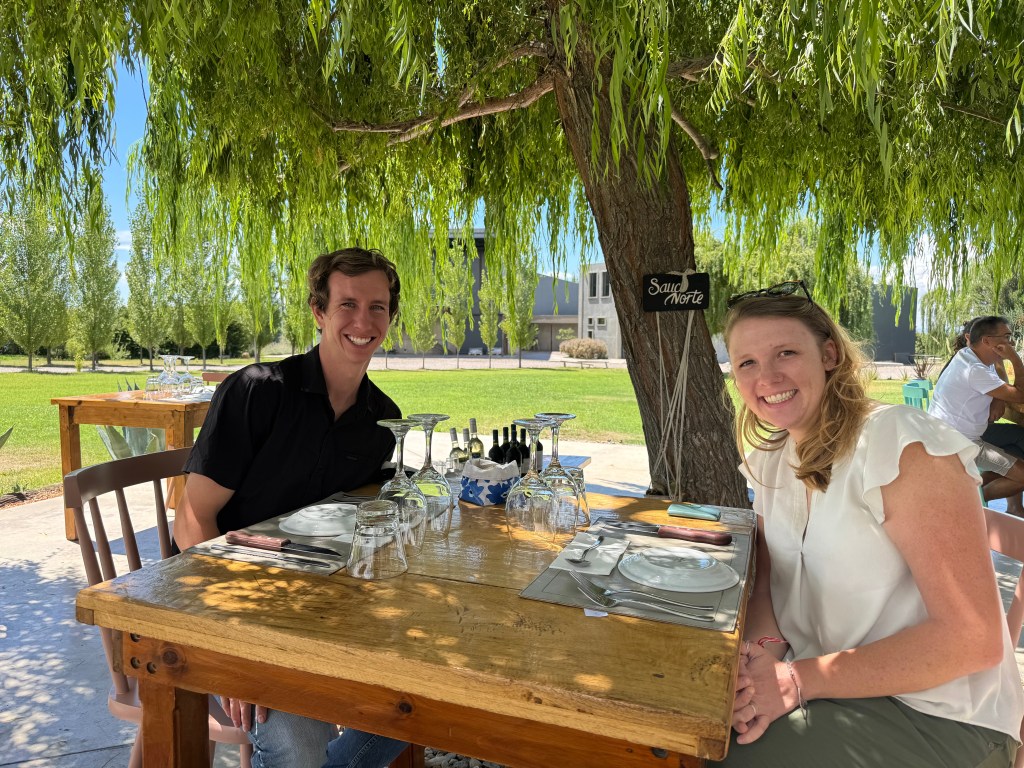
Our table was laid out in a afternoon garden party atmosphere. We were greeted by Pablo, whose family had been making wine there for three generations. He explained that while Malbec is the star of Mendoza, the region produces so much more. As he poured us our first taste – a crisp, refreshing TorrontĂ©s with notes of white flowers and peach – he explained this white varietal is uniquely Argentine and thrives in the high-altitude vineyards. 

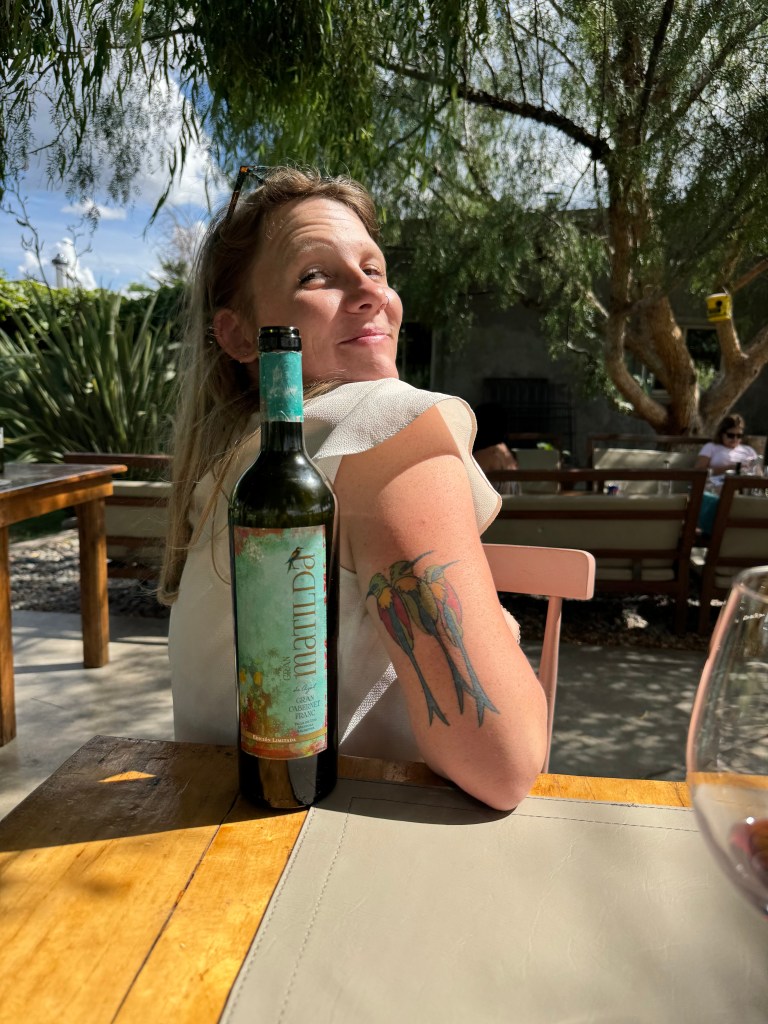
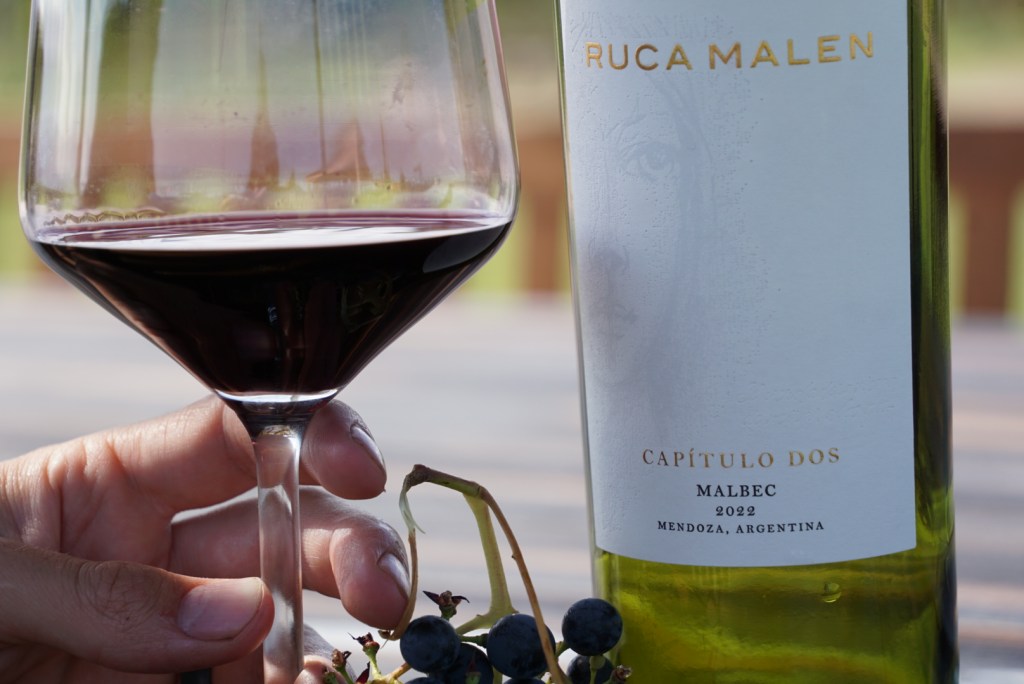
Next came a rosĂ© made from Malbec grapes, followed by the reds: a medium-bodied Bonarda (another Argentine specialty), a complex Cabernet Franc that Pablo said was his personal favorite, and finally, their reserve Malbec. This last wine was everything we’d hoped for from Mendoza – rich and velvety with deep plum and blackberry flavors, hints of vanilla and chocolate, and that characteristic violet aroma that makes Mendoza Malbecs so special. Pablo explained how the region’s high altitude, intense sunlight, and significant temperature variation between day and night create perfect conditions for developing these complex flavors in the grapes.

While swimming in the bottomless wines, we managed to also indulge in an amazing lunch of slow braised short rib. The meat literally fell off the bone as it was placed on our table and then proceeded to melt in our mouths. The neighboring table also commented on the idealic food, wine and scenery. We started to talk with them and they were a retired couple from Washington DC. We struck up a great conversation about the current political climate and if we should move to DC for a potential policy job for Nikki. While remaining somewhat apolitical (very hard with bottomless wine) they politely said they would not be relocating the DC anytime soon if they were us. As the afternoon progressed, we enjoyed wine after wine while continuing to talk with our adopted DC mentors. At the end of the afternoon the sweet couple asked what our favorite wine of the afternoon was and very discreetly bought us a bottle of it to celebrate our honeymoon.

We visited one more bodegas that afternoon, but honestly, they blurred together a bit as the tastings accumulated. We had decided to take turns being the designated driver and today was my day. On the drive back to the Airbnb, the Andes mountains providing a majestic backdrop in the distance, and we thought this was about as perfect a honeymoon as we could have imagined after months on the road.

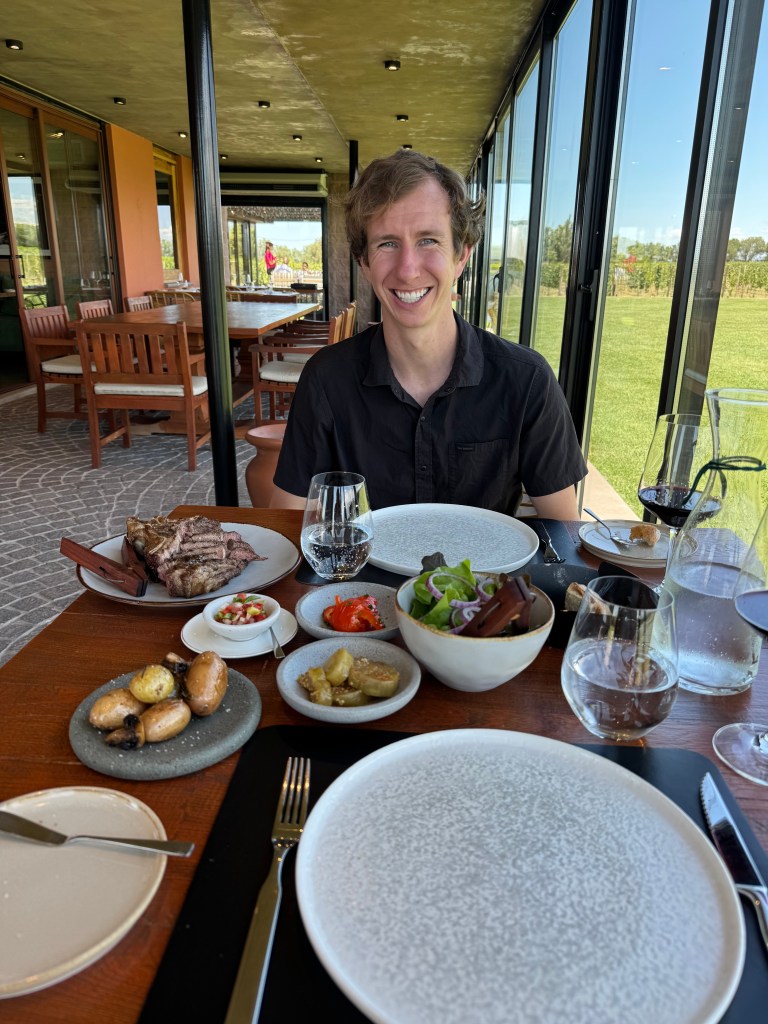
The next day was dedicated to our biggest splurge of the entire year-long trip – a nine-course lunch with wine pairings at Rucca Malen winery in the Luján de Cuyo region. We had been saving for this experience since before we left home, knowing that Mendoza would be on our route and that this particular winery was renowned for its food and wine pairings.

We drove our Tacoma the 30 kilometers from our stone house to Rucca Malen, arriving just before noon. The winery itself was stunning – a modern building of glass and stone set against the backdrop of vineyards and mountains. We were seated at a table on the covered terrace, offering panoramic views of the estate.

What followed was a four-hour gastronomic journey that I will remember forever. Each of the nine courses was designed to highlight both the local cuisine and a specific wine from Rucca Malen’s collection. We started with a delicate empanada paired with their YauquĂ©n TorrontĂ©s, followed by a goat cheese and beet salad with herbs from their garden, matched with a bright Brut sparkling wine.

The progression continued through increasingly complex dishes: a trout ceviche with their Reserva Sauvignon Blanc; tender lamb slow-cooked in a clay oven with their Reserva Malbec; a grilled flank steak that melted in my mouth paired with their flagship Kinien Malbec. Each pairing was introduced by both the sommelier and the chef, who explained the inspiration behind the combination and how the flavors were meant to interact.

By the time we reached the dessert courses – a refreshing sorbet palate cleanser, followed by a deconstructed alfajor with dulce de leche ice cream paired with a late harvest TorrontĂ©s – we were in a state of blissful satisfaction. The meal concluded with mate-infused chocolates and coffee served in the garden.

What made this experience all the more special was the contrast with our usual overlander meals cooked on our camp stove or cheap menu del dĂ­a lunches. After a year of budget travel, this extravagant meal felt earned, appreciated in a way that wouldn’t have been possible had we just flown in for a luxury vacation.

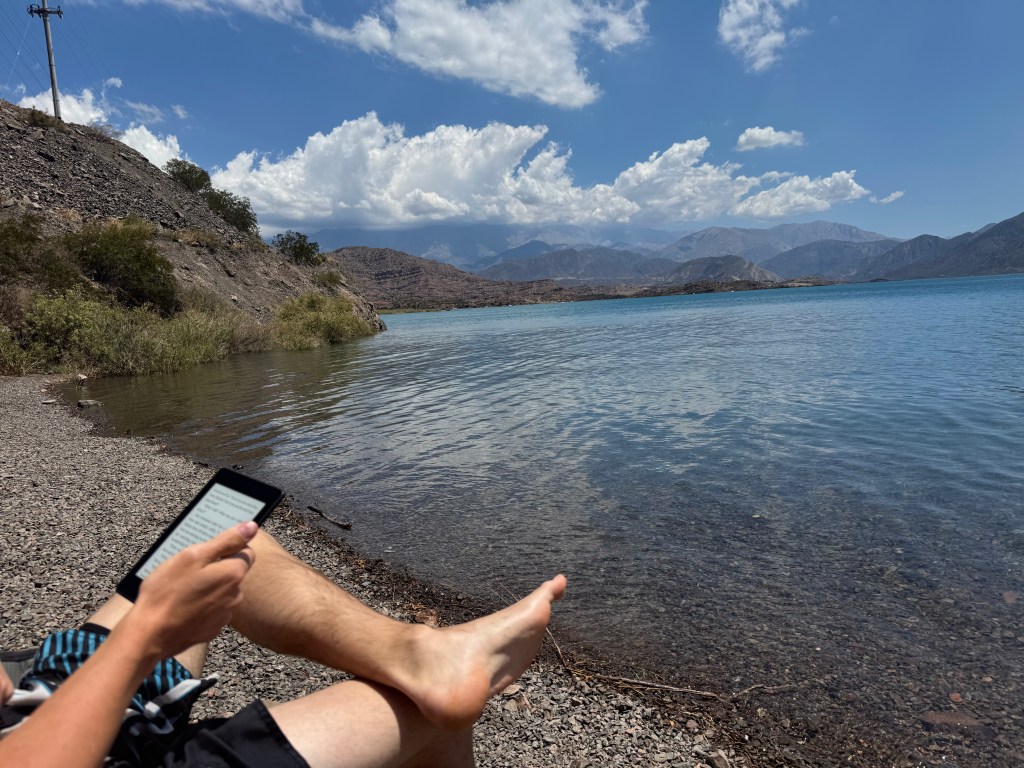
Our wine tasting had come to an end but not the honeymoon. We proceeded to drive to the Chile-Mendoza border and stopping at Lake Embalse Porterillos for some lake days. We had only planned for one lake day but ended up spending three days there because of how idealic the lake was. We were also joined on the 2nd day by 30 local Argentinians who gladly welcomed us for a typical Argentinian summer day and who kindly also gifted us a bottle of wine to celebrate our honeymoon. 

As our honeymoon week drew to a close and we prepared to continue our journey north toward Valle de ElquĂ­ (the pisco valley), we reflected on how perfect Mendoza had been for this milestone. We packed up our camper once more, adding a carefully wrapped bottle of Malbec gifted from our DC friends and the bottle of white from our beach friends. As we left the lakeside and hit the road again in our trusty Taka, I couldn’t help but feel we’d found the perfect balance – a honeymoon that honored both our marriage and our love of adventure, with memories (and flavors) that would last a lifetime.

Siete Tazas National Park – Lircay – Tricahue 

We were really grateful to be home for the holidays. Being travelers at heart and living across the continent from our families, we have had our fair share of missing holidays, birthdays, celebrations and hard times, but this year we felt strongly that we needed to be home for the holidays. We spent several days leading up to Christmas with me family (Nikki here today!), having sleepovers with my parents, Matt and Clarissa and grandparents, celebrating Christmas early and watching movies. We then spent Christmas day and the following few days with Colter’s family – parents, grandparents and Laini and Gabe, eating great food, playing games, and trying new drinks. We then packed up our car (not Taka – she’s safe in Santiago with the same company we left her with when COVID set in) and Naiya and Ollie to drive back to our little home in Pittsburgh, so that we could prepare it for the Fulbrighters who would be renting it out for the coming 6 months. We did a final clean and moved in for the week with Shannon to celebrate New Years and see other friends in Pittsburgh. 

However, just after midnight of New Years, my grandfather, Andy Dickson, passed away really unexpectedly. He passed away, after having rung in the New Years with Gran, as they were reflecting on the many passed New Years they had shared. While losing any family member ever is tough, that is truly a beautiful way to have signed out of this life. I caught the first flight to CO on Jan 1st and spent several days with my family, grieving and loving on Gran. She is coping and her biggest emotion seems to be gratitude he went so gently, and lots of reflections on the life they shared together for 61 years. I know this is our travel blog, but I want to take a few moments to share some of my favorite memories of Grandpa. The first one isn’t actually one I even remember, but Mom re-tells it. I was born a week early (which my family claims was the last time I’ve ever been early…), so Gran and Gramps hadn’t yet flown in from South Africa. Gran got in 5 or 6 days after I was born and Gramps a week later. And the way Mom explains it, the first thing Gramps did after arriving, before saying hi to Gran or Mom and Dad, was to peak into the back seat to say hi to his first grandkiddo (me). He loved all things mechanical and I will forever associate wooden and toy trains with him. He was an avid reader, easily cranking through a book a week and the toilet was his favorite “reading room”. He often shared articles with each of us that he thought we would enjoy or find interesting. He saved his favorite newspapers and journal articles to share in person, when they reminded him of one of us. For the 2010 Christmas, Mom and Dad gave me and Matt a pair of small dirt bikes, and I will forever remember Grandpa taking a turn, ramping up a dirt mound we had and diving headfirst over the handlebars into the dirt (he was totally uninjured physically, but his ego was definitely bruised). We celebrated Gran and Gramp’s 60th wedding anniversary in Belize as a family last year where we had a divine meal and reflected on their many beautiful years together. He was a serious man with a true love for history and engineering, but you could fairly easily crack him into a smile or pull him into a hug and he loved his family more than anything else. We ended up extending our stay in the States for a couple days to give me a chance to recover and get back to Pittsburgh, but we ultimately decided that it was a good time to hit the road again. 

Once back in Santiago, we happily reunited with Taka and headed back south. While we are ultimately heading North, there were a couple places we wanted to finish seeing just south of the city. The first on the list was Siete Tazas National Park (or 7 Cups – aptly named for their famous waterfall which cascades down into seven pools). We had actually tried to visit this park right before leaving last time, but the park was closed due to wildfires. We did a long hike in the park, with views over the valley,  giving ourselves a little time to get a little reacclimatized to long hikes, reminding our bodies that we weren’t on Christmas holiday anymore. We then did the iconic Siete Tazas walk which was stunning and well worth the name of the park. The blue, green river falls between white canyon walls, ending in a massive fall called the Lion’s Leap. 

We then went a little further south to the National Park Licray. Here we hoped to do a 5 day backpacking loop, but after talking to the park guards, they told us that the backside of the loop was currently closed because a private landowner wasn’t happy with how past campers had treated the land, which was sad to hear. We resigned ourselves to doing a 3 day out and back, packed up our gear, and left Taka in the safe arms of the park guards. The trek started out intensely, with a 14 mile day over a mountain pass where we saw gauchos who had just come up the other side of the pass, breaking for lunch and rest their weary horses. We hiked down the pass and out onto a cobbly riverbed. Those last couple of miles were a little excruciating as we had to navigate over and around rocks and boulders, and small river crossings, for several miles. We got into the refugio, where we could tell many gouchos overnighted – there was a fully built bunk house, bathrooms and tables. We found a secluded spot, in the otherwise empty campground, and set-up our tent for the night. We went to the stream to soak our tired feet and collect water for the day, and then snuggled into bed for the night. The next morning, we packed up, grabbing handfuls of fresh wild apricots for the road from the grove of trees near our campsite. We walked back out, along the river rocks and pit stopped at a beautiful waterfall, where we took a swim and a lunch break. We then had to climb back up the mountain pass we had cleared through, which was a slow and steady grind. We don’t usually listen to music or podcasts when we hike – we view it as one of our sacred times to talk about the biggest and deepest things in our life. And we love it that way. But this climb required a little pump up music. We did eventually make it and wandered into camp, weary and ready for a relaxing evening. 

This is when the trip got really exciting and gave us a story we will literally retell for the rest of our days. We usually abridge our stories for the blog, but this one is worth telling in full detail, so brace yourself for a story full of heroes (Colter), villains (a Mama cow), intrigue, conflict and resolution. 

To get into this refugio, we had to open up a gate and pass over a bridge. We did so easily, but as we were picking out our campsite, we noticed a cow walking through camp, using the path we had just come up. At the time, we didn’t think anything of it, as we had passed by cows all day. We picked our site and pitched our tent. As we were doing so, we commented on the cow, who was now licking off other picnic tables in the refugio. I said to Colter that the cow reminded me a badly behaved, massive dog. We both laughed and then commented on how much we missed our own pups. As we settled into eating our dinner, the cow started to wonder towards us. We figured she was interested by the smells, so we chased her off. But as we started doing dishes and getting into our pajamas, she started to become a little more persistent. I asked Colter “Do you think she’s going to give us hassles all night?” to which we both just laughed. Nah – there was no way a cow would be targeting us. As she returned for the fourth time, we wondered if we were in her path to the stream behind our site, so we let her pass through but she wasn’t interested in the stream and started smelling at all of our gear, so we chased her off again, this time shoo-ing her back down the path she had come up. We hadn’t seen her for ~20 min so we figured we were both safe to go use the bathroom and settle back into bed. I had a weird feeling, so looked back over my shoulder to check on our tent, and low and behold, Mama Cow was in our site!! We were worried she was going to trample our gear, which we really need for the rest of our trip so we sprinted back to the site. She snatched at a pair of my pants which were hanging in a tree to dry out. She missed on the first pass, but stumbled back and grabbed them and proceeded to start eating them. EATING MY PANTS! I cried out “Noooo!” because I had put a bracelet in the pocket while we were hiking that I was very attached to and really didn’t want to lose. We both ran at her, but she kept just out of reach, moving as we got just in reach of her. Colter then tried to prod her with a stick to see if she’d drop the pants for her own health but to also get the bracelet back with no avail and I said “it’s not worth getting kicked love – leave it”. I was sad about the bracelet and angry that this cow was beating us at the game of protection, so I went off along the path to see if we had somehow left the gate open. I found a section of fence that had fallen over and was clearly her path – I could see trampled grass leading up to the gap on both sides. I went back to tell Colter of my finding and found him standing with a triumphant smile on his face and a handful of steaming pants!! In the time I had been gone, he had managed to chase down Mama Cow and startled her into dropping the pants. He said it was just like interacting with a massive naughty dog who had something it knew it shouldn’t. He tried to do a trade, offering her a stick for the pants, and when that didn’t work, he jumped towards her which startled her, and she dropped the pants. I reached a hand into the slobber covered pants, and there was my bracelet, still safe and sound. Colter saved the day!! But our saga was not yet over. 

Up to this point, we hadn’t wanted to chase her back out of the refugio in case the gauchos left her inside on purpose, but at this point we knew she jumped the fence to come in and were getting a little scared for our safety, so we decided we’d chase her back outside of the refugio. We watched as she easily cleared the gap in the fence and then spent the next 30 min building up the gap in the fence with wood and fallen branches. We built it to 6’ tall and walked back to our tent, feeling a little rattled but better for knowing she was on the other side of the fence. We debated if we should move our tent into a little sheltered spot in the refugio, but reasoned that with the fence up and her on the other side of it, we should be fine. We moved all of our gear into the tent, just as a precaution in case she somehow did manage to come back. Everything, apart from the slobber covered pants. Well that was a mistake. 

At 2 am in the morning, we are both startled awake to the sound of hoof clomps running towards us (at our heads!) and towards the tree where my pants are hanging! She snatched them off the tree but dropped them and ran off. At that point, our hearts were both beating and our adrenalin was high. We debated if we wanted to run on shifts for the rest of the night, chasing her off, or if we wanted to move our tent into the sheltered area where we could situate between two picnic tables and be on a wooden deck which we thought would be a clear deterrent for her. We started with the alternating guard watch, but quickly decided it was just worth moving. We moved our entire tent (still fully pitched) along with all our gear, while fending off Mama who kept turning towards us. 

Once situated between the picnic tables, we hung the pants on a high-up rafter of the shelter that we thought was for sure safe from her reach. We finally felt we could settle back into sleep for the night. Boy did we continue to be wrong. Mama circled us for the rest of the night, like an angry bull yearning for a fluttering cape. She sometimes passed very close (we could hear her breathing), and sometimes wondered off into the forest and did a large pass of the area. At 4:30 am, we heard hooves on the wooden deck as she craned her neck up high to grab my freaking pants! At that point, it was so dark and she had terrorized us so much, that we just let the pants be. I had the bracelet back, and we had done our darndest to stop her from eating them for her sake. We lay awake, listening to her chomp on the pants like a piece of cud. We both dozed on and off, but at 7 am we called it quits on our attempt to sleep and got up for the day. We didn’t see her around, so we quickly packed up our gear, ate a breakfast and got ready to hit the trail, short a pair of pants. We went to use the bathroom before hitting the trail again, and Mama came charging out of the forest towards us. To this day, she won the battle, although we did end up finding my torn up pants in the middle of the trail, 400 ft from our second campsite. The bracelet now has a heck of a story with a cow chew mark in the corner piece of the heart pendant, and we have turned the pants into a pair of rather torn up shorts and I used the leg pieces to line our fruit basket. I’m not sure what lesson we were supposed to learn, but we were definitely out gamed by a cow that night. All that being said, the rest of the hike down was beautiful and easy. 

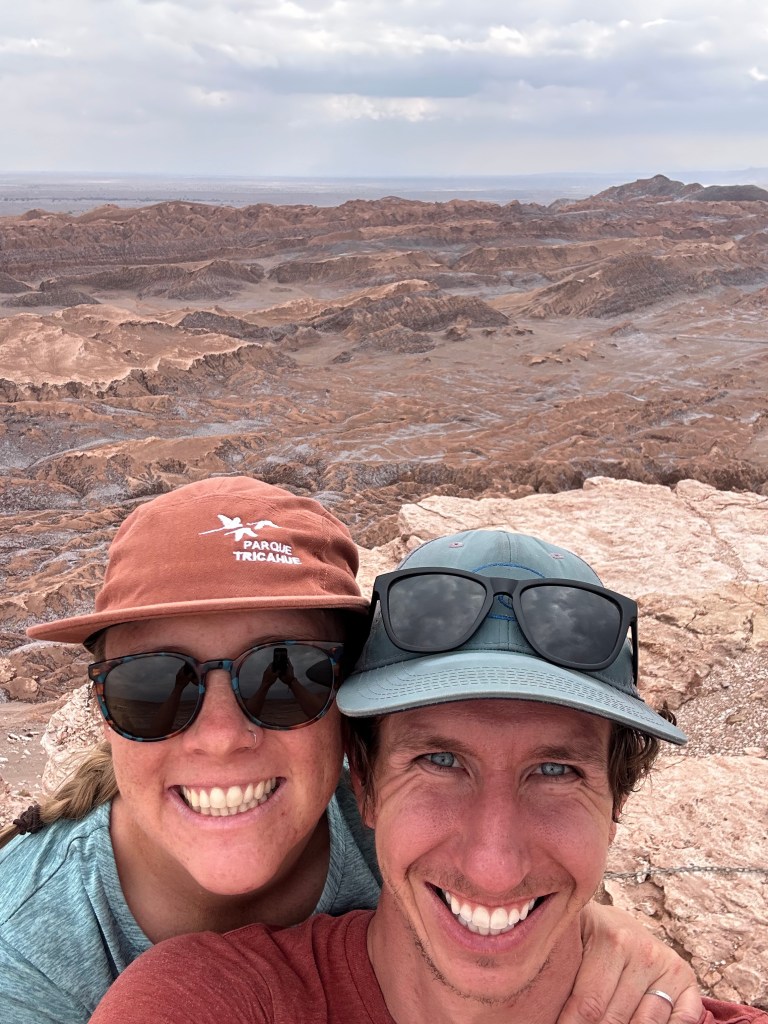
After admitting defeat to a cow, on an otherwise amazing backpacking trip, we moved on to our third park, a new small private park, called Tricahue, where we did a divine 14 mile hike, out to a waterfall and back. We swam along the river in our own private swimming pool, and then enjoyed a beer each brewed locally with the water from the river. We found another local brewery that evening and enjoyed beers with handmade pizzas. 

Propane, ChiloĂ©, Vicente Pèrez Rosales, Huerquehue National Park, Termas de Chillán and Constitution

Nikki and I said our last goodbyes to Matt and Clarissa as we watched them pass through security of the tiny Temuco airport. Our time with them was so special! We got to share our life on the road, overloading with them in one of our favorite places ever – the Cochamo valley. Our time with them felt like a shared a vacation, but now we were back to the two of us to brave the South American world. The first item on our to-do list was to finally find some propane… an issue that had been dogging us since we shipped the truck back in September. 

When we shipped our truck from New Jersey, we forgot that our two 10lb propane tanks were not completely empty and therefore we decided not to ship them with the truck due to the shipping regulations. We figured we could find the same size thanks in South America and use our adapters to connect to our US system. How wrong we were. Ever since arriving in Montevideo, we had been searching for these tall and narrow sized tanks. We had struck out everywhere in Uruguay and Argentina and then gave up looking while Matt and Clarissa were with us until a truck passed us on the highway and we saw the sized tanks we needed! 

With Matt and Clarissa off, our only goal for the day was to get propane. If we could accomplish this single task, we said we would go for a beer to celebrate! We drove into the city of Temuco and stopped at the first propane vendor we found. They did indeed have the 5kg tanks that we needed but they only exchanged tanks and would not allow us to buy a new one.   They did direct us to another shop that was willing to sell us two tanks. We officially had propane but it wasn’t quite usable yet. The tanks in Chile use a QUICK RELEASE valve and therefore we needed either an adapter or someone to help build us a new propane inlet system. This is where the beauty of the the app iOverlander comes in. This app is an offline crowd sourced database of anything an overlander would need. All we had to do was turn on the “mechanics and parts” filter to see hundreds of potential mechanics in the area. After reviewing the possibilities, we found a parts shop that had nothing but stellar praise from other overlanders. We knew this place could solve our, seemingly simple, problem. 

When we got the shop, we could see it wasn’t just a well-kept overlander secret. This shop was obviously famous in the area. It had a line out the door with everyone holding some car, electronic or any other type of part you could think of. My anxiety grew as I realized I would have to communicate our propane issue and what I wanted all in Spanish. While I am very comfortable speaking in Spanish about travel related items, I wasn’t fully confident in my ability to discuss an in-depth problem with our propane system. But with our US propane adapter in hand, I joined the line of other problem-havers. I watched as each person got to the counter, put their part of issue on the counter and explain their issue. The worker would then go to the back of the crazy shop and return with a solution. When I got to the front I confidently gave my elevator pitch that I had been practicing in my head and then the real game started. We went back and forth for another 5 minutes but in the end I felt confident that I had explained what we needed. He said he would need to make the parts but we could come back in 30 min. Sure enough, we came back to the shop to find he had fabricated a new inlet hose that would directly connect our new Chilean tanks to our camper. We had done it! We had full propane tanks and an ability to use them! We left the shop feeling so accomplished and it was only 3 in the afternoon… That was until we tried to hook the whole system up. The parts from the shop worked perfectly but the 5kg propane tanks were about an inch too tall to fit into the propane cabinet in the camper. We struggled for over an hour trying to get the tanks to fit while connected but it was not going to happen. In the end we found a way to have one tank connected and sitting at a 15 degree angle in the cabinet. We decided this was the best option but then we had to return the other tank and be at peace that we would only be at half capacity for the trip. But according to our goal at the start of the day, we had succeeded! We had propane and could finally cook in our camper and we did end up celebrating with a burger and beer at an Irish pub in the area.

Chiloé

We were finally cooking with gas (our favorite turn of phrase now) and ready to explore a new area of Chile. Our first new destination was the island of Chiloe on the western coast of Chile. This sleepy island is known to be different from the mainland due to retaining its alliance and collection with Spain during the country’s independence. Due to this, the island is still heavily Roman Catholic and houses 10+ wooden churches designated as UNESCO World Heritage sites. The island is also known for cute towns with colorful houses, penguin colonies and oysters. We thought this would be a excellent place to relax for a bit after our hiking focused time with Matt and Clarissa. 

To get to the island, we drove our car onto a ferry that took us across the channel separating Chiloe from the mainland. The ferry took only 30 min but in that time we got to take in the beauty of the Chilean fjords and see a few sea lions. Once on the island we made our first camp on the shores of the fjord and watched a beautiful sunset over the Patagonian mountains. We spent a total of three days on Chiloe and explored all it had to offer. We made a trip to the Capital city of Castro to see the brightly colored houses, do some local shopping and see one of the UNESCO World Heritage churches but the highlight of the island was an early morning kayak to a penguin colony. We had rented kayaks from a local and found ourselves at 7am on the water of cove protected from the Atlantic by a series of towering rock islands. These rock islands were also the perfect location for the colonies of Magellan and Humboldt penguins. We learned this is the only location in Chile were both of these types of penguins live together. The kayak out to the colonies was beautifully peaceful and seeing the hundreds of penguins starting their day was amazing! It was fun to see how awkward penguins are on land but then how adept they are in the water. We watched the penguins for the better part of an hour and then continued our kayak around the islands. As we were rounding the last island and watching all the other sea birds, something in the water caught the corner of our eye. We kept looking to see a sea otter pop up to the surface with a crab in hand – or paw! The cute otter then proceeded to swim on its back to the island and eat the crab. We both felt so lucky to have seen such a cool and unexpected encounter. Once back on shore, the kind man who had rented us kayaks, shared some of his own fresh caught crab for us to indulge in. 

The last thing we had to do on Chiloe was to eat the oysters the island is known for. On our last night there we found a very cute but empty oyster restaurant and enjoyed 15 oysters and a bottle of chilean wine with a lovely view of the ocean. Our time in Chiloe was exactly what we needed, some time to relax and getting settled into the rest of our time in Chile but then we were ready to get back to our true love of hiking!

Vicente Perez Rosales National Park

Our first hiking destination was a smaller, lesser known park called Vicente Rosales National Park. The park is in the lake district just north of the Patagonia region. The park is situated between the ever imposing Osorno volcano and Todos Los Santos Lake. We did one hike in this park and it was beautiful! The hike climbed up into the foothills of Osorno volcano before meandering around the crystal clear lake. The clear views of the volcano were breathtaking but then so was the cold afternoon plunge into the lake. It was good to get back to hiking!

Huerquehue National Park

Once we were in the hiking mode, we looked for our next destination. Luckily the lake district of Chile is full of of options. We made our way back to the Pucon area and to the Hurquehue National Park. We were excited for this national park because it contains some long and hard hikes that peak some of the mountains in the area and have views of Villarica, Llanin and other surrounding volcanoes. We were braced for two to three days of intense hiking. Unfortunately when we got into the park and talked with the ranger, almost all of the we had planned to do were closed for maintenance and there was only one hike open in the whole park. We were bummed to hear about the trail closures but the one open hike was one that we had planned to do. The hike was still pretty long and intense at 15 miles and 2,000 feet of elevation gain as it wound its way through many of the lakes in the park but it did not have the summits and views of volcanoes that we had hopped for. We still enjoyed our hike there even if it wasn’t what we had planned.

Termas de Chillán

After being slightly disappointed with our hiking in Huerquehue National Park, we set out for our next hiking destination, a small ski resort with a hike to a hot spring! Nikki is a huge fan of any hike that ends in a swimming destination so this hike already had good marks. It ended up totally exceeding our expectations and being one of our top 10 hikes we have ever done! The hike was a long 13 mile out and back with over 2,000 feet of elevation gain but it had so much to offer. The hike started with a steep forest section that quickly opened up to a fumarole valley with hot pots, geysers and the lovely smell of sulphur. The trail then quickly climbed up and over a mountain pass that gave amazing views over the ski area and two valleys. We then descended into the next valley to find numerous hot springs and beautiful mountain streams. At this time of the year the snow was still melting but the hot springs underneath created ice caves which we could walk both through and on. Finally the hike ended at the aforementioned hot springs and they were amazing! The hot spring was just upstream of another mountain stream so the hot water mixed perfectly with the cold snowmelt. Just by moving a couple of feet up and downstream you could be sitting in water that ranged from roughly 100 degrees to 40 degrees. We also were the only people at the spring the entire day. All of this made it the best hot spring experience we have ever had and added the hike to one of our all time favorites!

Constitution

At this point in the trip it was getting close to mid December and we had planned to travel back to the United States to spend Christmas in Colorado and then drive our dogs back to Pittsburgh to meet our house renters. We were looking forward to seeing some family and friends for the holidays as a short intermission to the trip. To prep for returning to winter in the northern hemisphere we thought it would be wise to soak up the South American sun while we could. We found a cute beach town close to Santiago called Constitution. We then spent three lovely days there just relaxing on the beach, and enjoying the unique rock formations on the coast. It was a nice chill way to finish off the first leg of our trip before driving to Santiago and going home for the holidays!

The Breton Brunch Bunch Take on the Lake District

On this trip, we are endeavoring to split the blog writing a little more evenly given that I (Nikki) am not applying for PhD programs or sitting on advisory boards or working for the World Bank while we’re on the road. So, get ready for slightly more sarcasm and definitely less actual funniness today as you’re stuck with me recounting our visit with Matt and Clarissa! 

Before I launch off on explaining our adventures, I have to start with by explaining our group name. Matt came to live with Colter and myself in a house on Breton Way in Fort Collins, during the summer of COVID in 2020, just after we’d returned from our first go at the trip. We used to refer to ourselves as the three musketeers because we get along so well and love to hang out so we were excited to have some (unexpected because we were supposed to be in Pittsburgh) quality time together. However, we soon needed a new name for our group because Clarissa and Matt wanted to spend the summer together and Clarissa also moved in with us. Our favorite shared activity, in addition to playing and training our new puppy Naiya, playing board games, sharing our panics about the uncertainty of the world and movie nights, was to make brunch all together.  We would spend 2 or 3 hours on weekends cutting potatoes, onions, tomatoes, avocado, and cooking up eggs to make burritos and it became our special tradition. So there you have it – we very happily subbed out the Three Musketeers for the Breton Brunch Bunch, which we are thrilled to share will officially be sticking around as Matt and Clarissa are engaged and getting married in the summer of 2026!

Back to our main story. We bumped down the unexpectedly packed street towards the Puerto Montt airport, racing against time to pick up Matt and Clarissa. No matter how much time we leave ourselves, the traffic down here almost always gets the better of us. We rounded the corner of the airport track and see two big backpacking backpacks with Matt and Clarissa peeking out from underneath them. We stuff them, the backpacks – not Matt and Clarissa, into the back of Kaya (the camper) and Matt and Clarissa hope into Tony (the Tacoma). Tony is really just made for two of us, but does have two trundle seats which Matt and Clarissa generously agreed to travel along in for the duration of their visit. They updated us on their eventful flight into Chile which included dealing with propane tanks we had asked them to bring (and which ended up getting confiscated and causing a major hassle for them), several lengthy layovers and a customs process so long that they ended up missing their last connection into Puerto Montt. There was some confusion on if “mañana” meant tomorrow or morning (it means both) when discussing with the gate agent when the next flight was available, but thankfully they were able to catch the flight in the mañana (we will let you decide which manaña it is). We heard their updates while driving to Ensenada, along Llanquihue Lake. 

We got into the little town of Ensenada and immediately Clarissa spotted a cute little coffee shop, on vibe with a Boulder or Oregon, complete with succulents and resident cat. We sat down for a latte and to catch up after having not seen each other in a few months. After catching up on life and latest news, our focus turned to preparing for the backpacking trip we were embarking on the next day in Cochamo Valley. We compared camping gear again, reviewed the path in, and made sure we had enough food and supplies. Comfortable we were ready to drive to the trailhead, we drove the additional 3 or 4 hours and get settled into our base camp before starting the 9 miles into Cochamo Valley. 

People call Cochamo Valley the “Yosemite of the South” and it absolutely lives up to that name. Colter and I had actually done this same backpacking trip in 2020, when we were here last time and it was one of our favorite parts of the last trip. When Matt and Clarissa said they were hoping to visit us, we knew this was one of the places we had to take them. Not only are the views spectacular and unique, but the climbing scene is unreal and the comradery of the climbers and backpackers in the valley creates a really special environment that we encourage anyone we know to get a chance to experience if they can. Because some of the climbers set up camp in the valley for months at a time, the backpacking track in is part use for backpackers and donkeys who are used to carry in supplies. We were our own donkeys, setting in with a pack each. We chit-chatted the whole way in, still having so much to catch up on having been apart for several months. Upon rounding the corner into the valley, Clarissa and Matt inhaled as they saw the iconic granite dome the valley is known for. We checked in with the camp hosts and picked which site we were going to make our temporary home. We were here a little early for the season, so we had our pick of the prime spots and picked a site sheltered by bushes but with views of both domes. 

We unfortunately had rain on the forecast for the four days in the valley, so we knew we needed to hike early in the mornings while there. We woke up early and set off on Sendero Trinidad. In order to get to the trailhead, we took a hand-powered chair pulley across the river, enjoying the views up and down the river valley as we each crossed one at a time. The trail was steep and had a lot of elevation fairly immediately. After some climbing, the rain started in earlier than we had anticipated, but we did make it the base of the major granite dome we had set off to see and had enough time for a snack break before deciding to turn around. We got back to base camp and settled into our tents, playing cards and eating snacks. 

We set off early again the next morning for the Paloma hike which we were all excited for because it entailed climbing up the side of the granite dome to get a view over the valley beneath. The hike was stunning, passing by some of the climbing areas and requiring the use of several ropes to scramble up particularly steep sections of the path. The views from the top were stunning, looking off down the whole valley over rivers and other granite rocks. We returned in time before the rain started pouring and the camp hosts asked if we could help carry some wood to the camp to light a fire in the shared refugio area. Matt and Colter volunteered to carry the wood, so Clarissa and I said we’d make hot coca and get dinner started (grumbling only a little about the stereotypical break down of duties). 45 minutes later, Clarissa and I were getting worried about where the boys were and the soups we’d made were starting to get cold. Both boys both soon rounded the corner of camp, carrying half a forest on their backs each. They collapsed at the door and recounted their story of how the camp hosts had taken off ahead of them, our boys barely able to keep up with them as they sprinted through the forest like mule deer at home amongst the trees and rocks. Both boys thought they’d load up their packs fully, underestimating how far they’d ran through the forest to the collection site and came back exhausted. We pulled them into the refugio and fed them soup and dinner and settled in around the fire to share stories with the other campers and travelers. This included sharing space with a drenched set of three brothers, who after deciding they needed a bros meet-up, underestimated how long camping gear can last without needing to be waterproofed and had been poured on the night before. 

The next morning, thankfully having properly accounted for our own waterproofing needs and waking up dry, we packed up our gear and headed back out the valley. As one does after 4 days of backpacking, our first priority was finding chips and beer which we did with great success. Having spent days backpacking, we had planned to spend the next 2 nights at a cute Airbnb in Ensenada. When I say cute, I can’t overstate how cute this place was. It was a tiny home, with a little stove and sitting room out on a beautiful plot of land. Clarissa liked it so much there, that we started looking at what homes in the area cost and day-dreaming about the days we could afford a house here to move in to together. We started to work our way through the shower line, cleansing ourselves of 4 days worth of dirt. But while Matt was showering, the power in the Airbnb died. Our host ran over to tell us that the power in the whole area had actually died, but not to fear as he had a generator that we could run our showers and lights on until 9 pm. We finished our showers, got supplies for the evening, and had a divine fire-lit picnic in the living room of this precious Airbnb, snacking on cheese and crackers and fruits and jams and wines. 
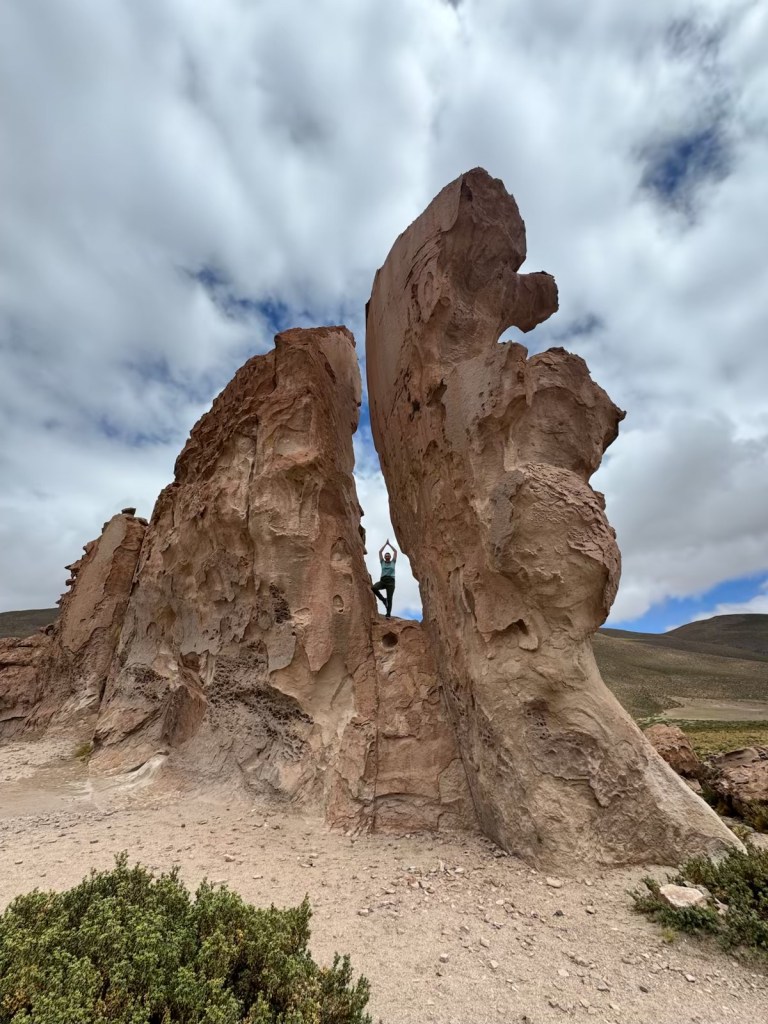
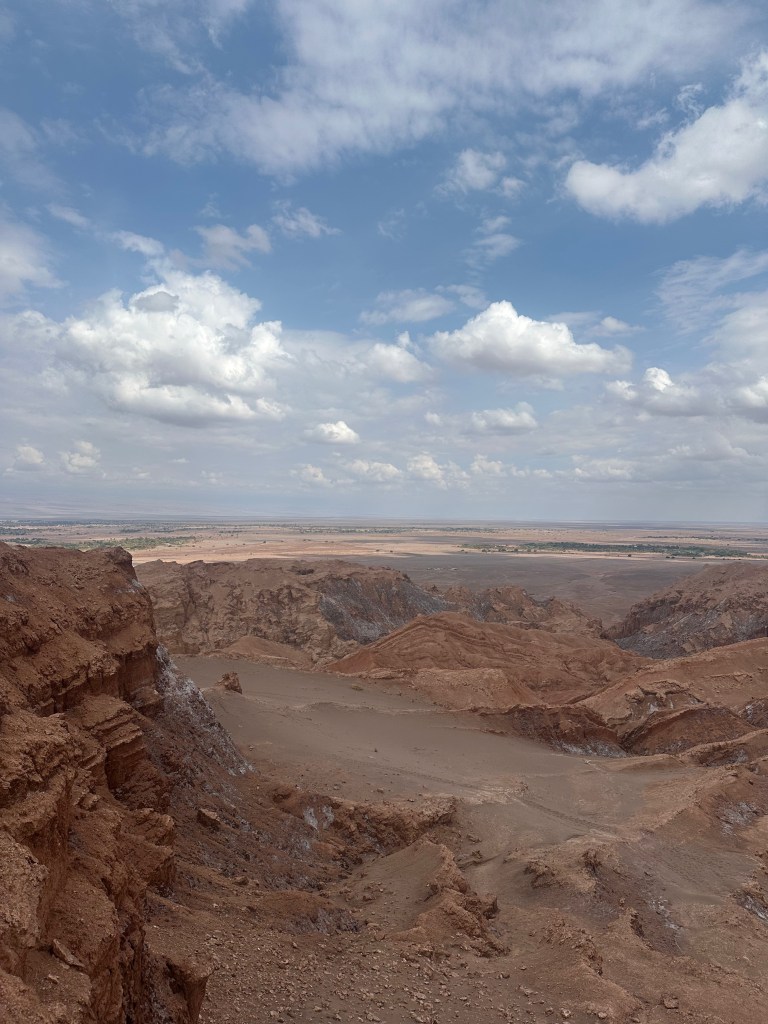
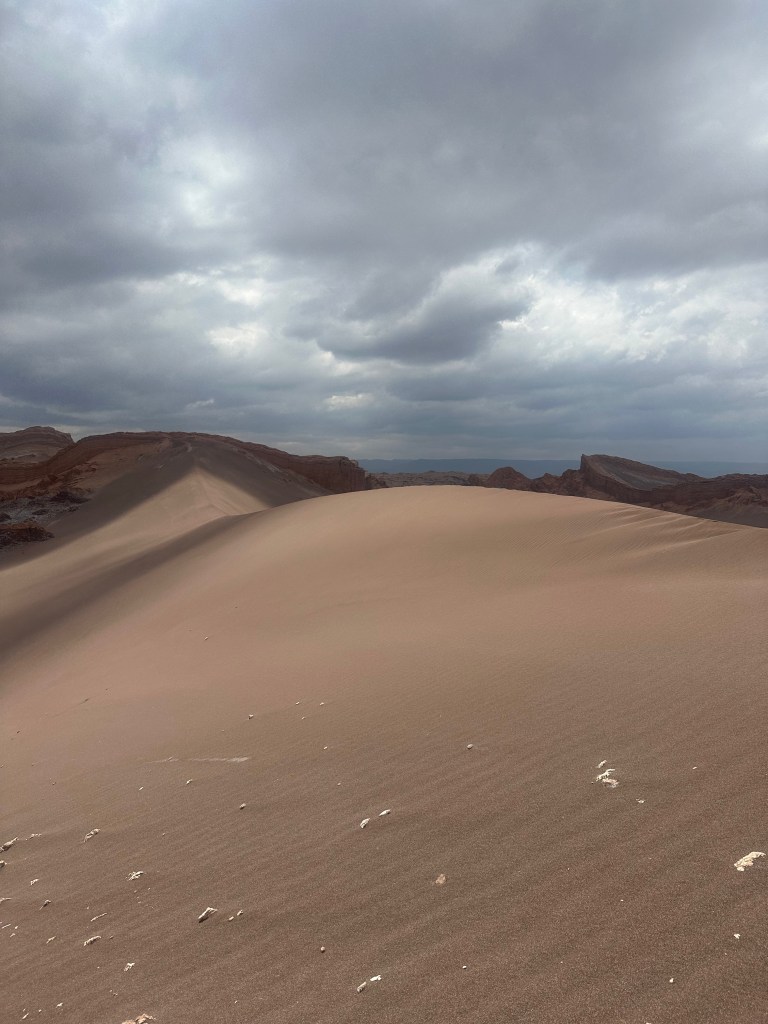
The next day was a totally chill day. We spent the morning making our go-to favorite meal, brunch! And making friends with a sweet cat that lived on the premise, who Matt and Clarissa affectionally named Smalls. There was much debate on if they could manage to adopt her to bring her home as Clarissa and Smalls made a tight and fast bond, Smalls riding on her shoulders as we did a little hike around the property and Clarissa going back to town to find natural tuna to feed Smalls. Ultimately, they decided that their two furry friends at home wouldn’t love the addition of a third, and so we spend the day enjoying Small’s company and snuggles knowing she’d stay at the property. 

The next day happened to be Thanksgiving and our longest drive day of the trip with them. It’s funny when you’re living in a country that doesn’t celebrate the holidays you’re used to – you kind of forget that they’re happening until you see another American couple and wish them a happy XYZ day. I felt the same emotion when living in Rwanda and Switzerland – it’s amazing how much of our enjoyment celebrating special occasions comes from the culture and tradition of sharing it with the people around you. We stopped for a fantastic meal, in a small town where I actually took my biggest PhD interview in while we were on this trip last time, and continued to make our way to our next stop in Pucon. We got into Pucon late but managed to find some dinner and crash into our beds. 

The next day we spent exploring the Pucon area. We went for our favorite meal to a cute cafĂ© that Clarissa had found and enjoyed exploring the city and meandering through the markets. Colter and I had to do some errands – exchange money, mail postcards, look for propane hook-ups – so Matt and Clarissa went off to explore a little by themselves and came back with prizes of knitted sweaters and stories about Grandmas who sold then said sweaters. 

The next day, we all hiked up Villarica, the most active volcano in South America. If you have been following along with our blogs since the beginning, first off thank you, but secondly, you might remember that Colter and I actually hiked this volcano with his parents when they visited us in Feb 2020. We loved it so much – the hike up, the sledding down with an ice ax – that we wanted to make sure Matt and Clarissa got to experience it too! So we hiked back up the massive volcano, using ice axes, crampons, and a whole set of snow clothing to make it to the summit. We saw several skiers ski off the top of the volcano and did the iconic sled down ourselves. 

The next day, we packed up our things one last time and headed to our final national park with Matt and Clarissa, Congiguillo. This park was stunning. With aquamarine lakes and stunning hikes with views of the same volcanoes we had just climbed, we were excited to spend some time out in our camper. However, when we got there, we found that the park guards had all gone on strike. None of the gates were down and online indicated that we could still pass into parks even if the guards weren’t there, but we weren’t sure where we were going to camp if there was no one to let us into the CONAF (Chile’s National Park management) to let us into the campgrounds. Thankfully we found a cute little eco-lodge in the park that allowed us to park Taka (affectionate combination of Tony and Kaya) in their parking lot and Matt and Clarissa opted for an ecolodge room for the night. The next day we did the Sierra Nevada hike which was stunning. We saw Monkey Trees (which the area is famous for), massive tarantulas (which other hikers informed us are fondly called chicken spiders in Chile because they are the size of a chicken) and stunning views. 

We spent one more night on the property of a sweet, older Chilean man who was thrilled to have his first Americans staying with him and then got Matt and Clarissa packed up to take them back to the airport. We said teary goodbyes (on Matt’s and my behalfs) and sent them safely on their way back home, eager to share the next adventure with our precious Breton Brunch Bunch. 

Design a site like this with WordPress.com
Get started